
Melden Sie sich bei getAbstract an, um die Zusammenfassung zu erhalten.
Melden Sie sich bei getAbstract an, um die Zusammenfassung zu erhalten.
Roger C. Schank, Ph.D.
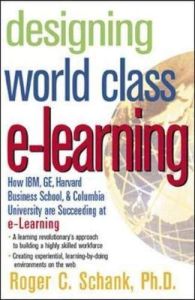
Designing World-Class E-Learning
How IBM, GE, Harvard Business School & Columbia University Are
McGraw-Hill, 2002
Was ist drin?
Beyond technology: how to create e-learning that meshes with the way people really learn.


Zusammenfassung verfügbar: weltweit
Recommendation
E-learning expert Roger C. Schank describes the secrets of a good e-learning program. He emphasizes using e-learning to train in-house employees, although his methods could work in any setting. Schank clearly establishes the basic principle that makes e-learning work: learning by doing. He outlines methods using scenarios and simulations that permit the learner to put new ideas into practice immediately. He’s a little too fond of failing and trying over as a learning method, when one might learn just as well by studying others’ failures and successes. However, he supports his approach with education-based examples that demonstrate how children learn, along with an inside look at IBM and GE programs. Visuals in the book show the computer screen in a teaching mode as displayed to the user, so you see how your e-learning material should look, whether on a Web site or on a local intranet. getAbstract.com recommends this solid hands-on instruction manual for training and development managers, and for those who are building e-learning experiences.
Summary
About the Author
Roger C. Schank, Ph.D., is a Distinguished Professor of Computer Science at Carnegie Mellon University, and the founder and chairman of CognitiveArts, a leading e-learning development firm. He also runs Schank Learning Consultants, and is an author and lecturer, as well as the inventor of powerful multimedia training tools. He founded the Institute for the Learning Sciences at Northwestern University and directed the Artificial Intelligence Project at Yale University. He has published more than 125 articles and books, including Coloring Outside the Lines, Dynamic Memory and Engines for Education.




Comment on this summary