
Melden Sie sich bei getAbstract an, um die Zusammenfassung zu erhalten.
Melden Sie sich bei getAbstract an, um die Zusammenfassung zu erhalten.
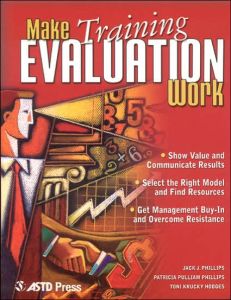
Jack J. Phillips, Patricia Pulliam Phillips and Toni Krucky Hodges
Make Training Evaluation Work
ASTD Publications, 2004
Was ist drin?
Feedback without tears: How to make evaluation a normal part of your training and learning process


Zusammenfassung verfügbar: weltweit
Recommendation
Although managers are aware of the need to evaluate their corporate learning and training programs, many are unsure how to proceed. Evaluation experts Jack J. Phillips, Patricia Pulliam Phillips and Toni Krucky Hodges are here to help. They offer a useful, practical manual for implementing solid evaluations of your learning programs. This nine-chapter workbook presents a lot of information and includes useful lists and tables. Whenever the authors recommend an evaluation of a particular kind of training, they provide a list of questions or a sample survey. They use up-to-date industry standards, and demonstrate an understanding of the history and development of learning-program evaluation over the past several decades. getAbstract finds that their workbook prioritizes simplicity, ease-of-use and thoroughness – the very traits they recommend for your evaluation program.
Summary
About the Authors
Jack J. Phillips, Ph.D., wrote The ROI Process, which provides accountability data for training, performance, human resources and technology programs. Patricia Pulliam Phillips, Ph.D., heads the ROI Institute, a global information source. Consultant Toni Krucky Hodges has more than 23 years experience in performance measurement and evaluation.



Comment on this summary