
Melden Sie sich bei getAbstract an, um die Zusammenfassung zu erhalten.
Melden Sie sich bei getAbstract an, um die Zusammenfassung zu erhalten.
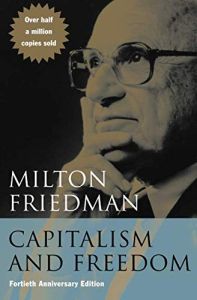
Milton Friedman
Capitalism and Freedom
University of Chicago Press, 2002
Was ist drin?
Ask not what economist Milton Friedman believes: this 1962 classic made him an oracle for traditional economics.


Zusammenfassung verfügbar: weltweit
Recommendation
This is a new edition of Milton Friedman’s classic 1962 capitalist manifesto. As such, it was ignored, spurned and hated for decades by the intellectual, post-Keynesian establishment. In the 60s, Friedman once found himself debating a liberal who attacked him by simply reciting Friedman’s views of the proper role of government. This was working rather well with the audience of college students until he quoted Friedman’s opposition to the military draft. Friedman suddenly found himself awash in the unexpected cheers of students. Perhaps it was a foreshadowing of his career. Friedman won the Nobel Prize in Economics in 1976, and his ideas gained some degree of mainstream acceptance in the Reagan years - although many of his thoughts remain controversial. To the extent that Friedman debunks myths about the Great Depression that are widely accepted as fact, perhaps he has a point about the semi-privatization of education. getAbstract strongly recommends this volume to those who seek a deeper understanding of government’s role in a free-market economy.
Summary
About the Author
Milton Friedman, a noted research fellow at the Hoover Institution, is the Paul Snowden Russell Distinguished Service Professor Emeritus of Economics at the University of Chicago. He won the Nobel Memorial Prize in Economics in 1976. In 1980, he and his wife collaborated on his best-selling book, Free to Choose. Capitalism and Freedom, first published in 1962, is considered his classic work.

Comment on this summary