
Join getAbstract to access the summary!
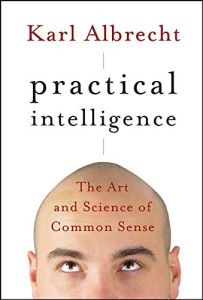
Join getAbstract to access the summary!
Karl Albrecht
Practical Intelligence
The Art and Science of Common Sense
Jossey-Bass, 2007
What's inside?
Effortlessly develop your reasoning skills using this friendly guide.


Summary availability: Worldwide
Recommendation
Everyone knows a few super-smart people who continually do super-stupid things. Sure, they can finish a Sunday New York Times crossword puzzle in less than 10 minutes, play and win three simultaneous chess games handily and multiply seven-digit numbers faster than a calculator. But they also can’t hold a job, are given to fulminating about bizarre pet causes (“Restore the Carolingian Dynasty now!”) and can’t shut up about their “brilliant” ideas (“You mean you didn’t read my 427-page proof of Goldbach’s conjecture yet?”). What’s going on? Well, if Karl Albrecht’s ideas are right, IQ isn’t the whole story of human intelligence. And it may not even be most of the story. Perhaps more important than raw IQ, particularly in today’s world, is practical intelligence: the ability to use common-sense reasoning in a structured way to solve relevant problems. Fortunately, practical intelligence, like other mental skills, is not fixed at birth. How can you develop it? Start with this sensible book, which getAbstract recommends to anyone who wants to be not only smart but also effective.
Summary
About the Author
Karl Albrecht is a management consultant, futurist, speaker and author.








Comment on this summary
“Convergent thinking” is classic problem solving, where you reduce a big, heterogeneous problem into simpler, homogenous constituents.