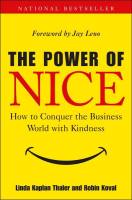
The Power of Nice
How to Conquer the Business World With Kindness
Category: Career & Self-Development
It’s nice to be nice. It’s also smart business.
In this summary you will learn
- Why social Darwinism is a myth
- Why it pays to be nice in business and in life
- Why cooperating is better than competing
- Why lying is stupid
- Why being nice means being empathetic
getAbstract rating
| getAbstract rating |
Applicability |
|
Innovation |
|
Style |
Why you should read The Power of Nice
Niceness has a bad name in business. Indeed, usually it seems as if the bad boys and girls get ahead, not the good and kindhearted. No one would call former GE chief Jack “Neutron” Welch or Leona “Queen of Mean” Helmsley nice. But Welch started poor and is now worth $720 million. High-school dropout Helmsley was a billionaire until her tax-evasion fall. Authors Linda Kaplan Thaler and Robin Koval say these two toughies are not-so-nice exceptions that prove the rule: Being nice is not only the right way to act, it is the smart way to get ahead. The authors present real-life examples of nice guys who finish first. They demonstrate that treating people well pays in the end. getAbstract endorses their humane premise, while confessing some skepticism about their cheery take on how the world works. If you’ve lost a promotion, for instance, you might not agree that life is always sunny. The authors say hard work, not influence, always wins. Not necessarily, alas. However, this optimistic book has a lot of positive messages, including information nuggets labeled “nice cubes.” One says you can ease people’s stress by giving them chocolate. Another notes that you can make yourself and others feel better by smiling at them. That rings true: Any day when you get chocolate and a smile can’t be all bad.
About the Authors
Linda Kaplan Thaler and Robin Koval are CEO and president of The Kaplan Thaler Group, a fast-growing, New York advertising agency. In 2005, they co-wrote Bang, a bestseller.
Do you like this summary?
Customers who read this summary also read
-
Everyone Communicates, Few Connect
What the Most Effective People Do Differentlyby John C. Maxwell
-
The Optimism Bias
by Tali Sharot
-
Smart Trust
by Stephen M.R. Covey, Greg Link and Rebecca R. Merrill
-
The Elephant in the Boardroom
by Adrian Furnham and John Taylor