
Join getAbstract to access the summary!
Join getAbstract to access the summary!
Richard H. Thaler
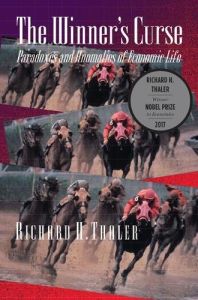
The Winner's Curse
Princeton UP, 1994
What's inside?
If you believe people make rational economic choices, think again. Do all your expenditures meet the sweet reason test?


Summary availability: Worldwide
Recommendation
getAbstract.com highly recommends this classic of economic literature, one of the first (more or less) accessible presentations of the evidence against economic rationality. Economists have assumed, conventionally, that economic choice rests on a foundation of rationality. For instance, economists tend to think that people will put the same value on two mathematically identical offers. Yet laboratory experiments have proven what everyday experience suggests: people are not quite rational. Author Richard H. Thaler, a founding father of behavioral economics, presents convincing exhibits to make the case that the assumption of economic rationality is an awfully big pill to swallow. Stylistically, his book strikes a neat balance between accessibility and obscurity. A reader will need a certain amount of schooling in economics and a great deal of patience with academic prose to wade through every word of every chapter, although the payoff is substantial. However, it is possible for the impatient reader to get the gist by reading the introduction, the first page or two of each chapter and the epilogue. And even that is eminently worthwhile.
Summary
About the Author
Richard H. Thaler is a professor of behavioral science and economics at the Graduate School of Business at the University of Chicago.

Comment on this summary