Skip navigation

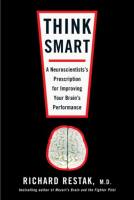
Think Smart

A Neuroscientist's Prescription for Improving Your Brain's Performance

by Richard Restak, M.D.

Riverhead, 2009

Category: Concepts & Trends

Get the summary
Think Smart
Brain training: How to care for your brain and improve its performance as you age

In this summary you will learn

  • How your brain develops as you mature
  • What you can do to maintain your brain’s health as you age
  • How you can improve your brain’s performance

getAbstract rating

getAbstract rating (?)

(8)

Applicability

(9)

Innovation

(6)

Style

(9)

Level of Expertise (?)

(5)

Why you should read Think Smart

Merriam-Webster’s Collegiate Dictionary defines the brain as “the portion of the vertebrate central nervous system enclosed in the skull and continuous with the spinal cord through the foramen magnum that is composed of neurons and supporting and nutritive structures (as glia) and that integrates sensory information from inside and outside the body in controlling autonomic function (as heartbeat and respiration), in coordinating and directing correlated motor responses, and in the process of learning.” Phew! Luckily, neurology professor Richard Restak is here to synthesize contemporary research about the brain into applicable, accessible information. He doles out pertinent advice about how to look after your brain, including what to eat, how much to eat and what not to eat. He also explains how sleeping can maximize your creativity and brain health. Restak manages to make many of these suggestions for healthy living sound intriguing, even fun. getAbstract recommends this light scientific guide to readers who want to enhance their creativity and improve their brain’s performance.

About the Author

Richard Restak, M.D., clinical professor of neurology at George Washington University’s Medical Center, is the author of 18 books, including Mozart’s Brain and the Fighter Pilot.


Do you like this summary?

8

Comment on this summary

Be the first to write a comment!

Sign in to share your opinion

Want More?

Buy the book

Customers who read this summary also read
