
Join getAbstract to access the summary!
Join getAbstract to access the summary!
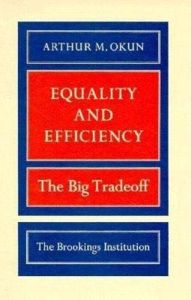
Arthur M. Okun
Equality and Efficiency
The Big Tradeoff
Brookings Institution Press, 1975
What's inside?
Capitalist democracy balances human rights and market efficiency – if only it could close the gap between rich and poor.


Summary availability: Worldwide
Recommendation
In the 1974 Godkin Lecture at Harvard University, prominent economist Arthur M. Okun addressed a pressing social conundrum: how human rights and the free market mutually inhibit each other. In this book, which revises and expands that presentation, the late economist ventured beyond his field’s customary territory by examining the nonfinancial benefits of an egalitarian society and explaining how the U.S. could move further in this direction. With clarity and wit, he discussed such issues as the nature of rights and of free markets, private versus public ownership, and the difference between equality of opportunity and equality of income. In other hands, these subjects might seem dry and technical; here they do not. The book is more than 30 years old. Therefore, unsurprisingly, some of its assumptions and predictions about public opinion and policy are dated (for example, the projection that U.S. politicians would be unlikely to question Social Security’s success) and the statistics are positively quaint, such as a U.S. national mean income of $14,000. Nevertheless, getAbstract recommends this amazingly still fresh, lucid discussion to policy makers, students of the economy, journalists and socially concerned executives.
Summary
About the Author
The late Arthur M. Okun served as chairman of the President’s Council of Economic Advisors for five years and was a senior fellow at the Brookings Institution. His theoretical work often focused on the classic problem of balancing inflation and unemployment.

Comment on this summary