
Join getAbstract to access the summary!
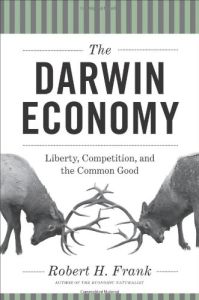
Join getAbstract to access the summary!
Robert H. Frank
The Darwin Economy
Liberty, Competition, and the Common Good
Princeton UP, 2011
What's inside?
America’s economy needs a government that functions without gridlock.


Summary availability: Worldwide
Recommendation
Philosopher Adam Smith himself was skeptical about the real-world results of his “invisible hand,” but you’d never know it by the way modern-day free market fundamentalists try to push every regulation out of the way. As Cornell economist Robert H. Frank notes in his assault on the ideological force field that has blocked much US government action, naturalist Charles Darwin identified the problem: Evolutionary incentives benefit individuals, not groups. Frank uses that insight to argue that government must abridge some personal gains for the greater good. Frank is an economics professor, and his book sometimes falls into a challenging didacticism. But he writes with admirable clarity and verve, and – while his prediction that the world will one day recognize Darwin as the father of economics is perhaps a reach – he has done nothing less than provide a fresh intellectual foundation for progressivism. While always politically neutral, getAbstract recommends Frank’s treatise to lawmakers, economists, historians and civic-minded professionals who are concerned with the large questions society must tackle.
Summary
About the Author
Robert H. Frank is a professor of economics at Cornell University and a frequent New York Times columnist. His books include The Economic Naturalist.

Comment on this summary
or the consumption tax finally will harm the society?