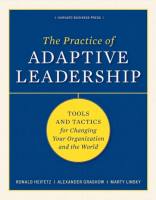
The Practice of Adaptive Leadership
Tools and Tactics for Changing Your Organization and the World
Harvard Business Review Press, 2009
Category: Leadership & Management
To change the world you need to start with yourself.
In this summary, you will learn
- How “adaptive leadership” can help you solve seemingly intractable problems
- Why leaders should diagnose, organize and self-assess before acting
getAbstract rating
| getAbstract rating |
Applicability |
|
Innovation |
|
Style |
|
| Level of Expertise |
Why you should read The Practice of Adaptive Leadership
So many of the world’s problems, and the issues that businesses and people face every day, can seem intractable and unsolvable. Leadership consultants Ronald Heifetz, Alexander Grashow and Marty Linsky propose a new way to lead the charge to change: “Adaptive leadership” calls for shedding outdated approaches and embracing new skills and attitudes to guide organizations in the 21st century. The authors’ counsel combines wisdom from psychology, biology, language and business with a healthy dose of self-assessment to help you and your company face ongoing challenges. Filled with useful exercises, real-life examples and thoughtful asides, their book can help you make difficult decisions about change. This process takes time, energy and self-knowledge, but the rewards you and your organization will reap are worth it. getAbstract recommends this inclusive leadership manual and its lessons about leading adaptively to budding and current business leaders, heads of nonprofits, and politicians who face challenges that require new responses.
About the Authors
Ronald Heifetz and Marty Linsky co-founded Cambridge Leadership Associates, where Alexander Grashow is CEO.
Do you like this summary?
Comment on this summary
-
September 30, 2011 Yessenia Batista"Globalization, the economic downturn, and the challenges the world faces in the 21st century demand an evolutionary approach to leadership." I agree that we need innovative leadership. Also, I really believe one of the biggest hurdles to change is conflict. Adaptive leaders have to harness conflict as an engine of creativity and innovation. It is a hard process but as the author says "remain realistically upbeat".
Customers who read this summary also read
-
Flat Army
Creating a Connected and Engaged Organizationby Dan Pontefract
-
Spiral Dynamics
by Don Edward Beck and Christopher C. Cowan
-
Humanize
by Jamie Notter and Maddie Grant
-
The New Entrepreneurial Leader
by Danna Greenberg, Kate McKone-Sweet and H. James Wilson