getAbstract

Home | Knowledge Packs | Travel Packs |
Blog | RSS Feeds | Free Summaries

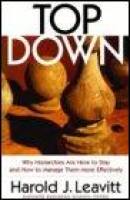
Top Down

Why Hierarchies Are Here to Stay and How to Manage Them More Effectively

by Harold J. Leavitt

Harvard Business Review Press, 2004

Category: Leadership & Management

Get the summary
Top Down

getAbstract rating

Overall (?)

rating 8 (8)

Applicability

rating 7 (7)

Innovation

rating 8 (8)

Style

rating 9 (9)

Level of Expertise (?)

rating 6 (6)

User rating

  (8.0)

In this summary you will learn

  • Why hierarchies are here to stay for the foreseeable future
  • How to evaluate the pros and cons of hierarchies
  • How to operate as a "humanizing" middle manager with "social influence" in an authoritarian corporate structure

Why you should read Top Down

This book could be subtitled "A Survival Manual for Those Stuck in the Middle." In the modern hierarchical (read "authoritarian") organization, the beleaguered middle manager is indeed stuck in the middle. Author Harold J. Leavitt is a self-professed "humanizer" who acknowledges the dehumanizing, authoritarian tendencies of the modern hierarchical organization. However, he goes beyond automatic humanistic inclinations to ask an important question: "What’s the alternative?" Hierarchies have structured human activity for centuries. They’ve learned to cloak themselves in commoners’ clothes in order to do business in egalitarian cultures, but don’t let that fool you. Large organizations are still ruled by hierarchies, and woe unto the middle manager who forgets it. Leavitt’s book evinces empathy for the plight of the unsung middle manager who has to meet the company’s objectives while helping it appear to be something it’s not: caring and humanistic. getAbstract.com highly recommends this book to all managers caught in the middle - which is to say, all managers.

About the Author

Harold J. Leavitt is the Kilpatrick Professor of Organizational Behavior emeritus at the Graduate School of Business at Stanford University. He served as director of the Stanford Executive Program for several years. He has taught at the University of Chicago, Carnegie Mellon University, the London Business School and INSEAD. He also wrote Managerial Psychology.

Comment on this summary

Be the first to write a comment! Sign in to share your opinion