Acesse a sua conta getAbstract para obter o resumo!

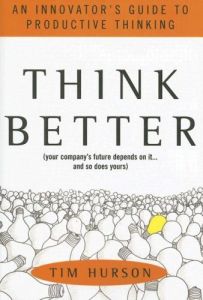
Think Better

Acesse a sua conta getAbstract para obter o resumo!

Think Better

An Innovator's Guide to Productive Thinking

McGraw-Hill,

15 min. de leitura
10 Ideias Fundamentais
Texto disponível

Sobre o que é?

Creativity is not innate. With the right tactics and a lot of practice, anyone can become an innovative thinker.

Editorial Rating

7

getAbstract Rating

  • Well Structured
  • For Beginners

Recommendation

Tim Hurson begins with a simple premise: Anyone can learn to “think better” – in other words, more creatively and productively. He says that by applying his methods, anyone can reliably come up with fresh ideas and solutions. If you’ve dipped into the fields of creativity, innovation or brainstorming before, you may find yourself nodding along, since his initial ideas are not surprising. Similarly, some of the techniques Hurson offers and the examples he shares to illustrate them will be familiar to anyone who has even a passing acquaintance with the field. However, others of his techniques are new. Hurson supplies prompts, basic diagrams, questions and examples. He adores mnemonics, formulas and acronyms. The book is written clearly and simply enough to appeal to inexperienced readers. However, getAbstract especially recommends it to managers and trainers with knowledge of the field; you’ll be more able to quickly see the distinctions between Hurson’s techniques and other brainstorming methods and appreciate the value he is offering.

Summary

Thinking About Thinking

Many people believe that thinking ability is innate – but that’s not true. Anyone can – and should – learn to think better than he or she does right now. The economy is shifting: No longer based on things, it’s now based on information. Thus, your company’s greatest asset is its ability to understand and manipulate information and ideas.

As the first step in improving your thinking, you must face the unpleasant reality that you don’t think as much as you assume you do. No one does. Instead, most people avoid thinking whenever possible; indeed, avoidance is so common that you can categorize the techniques for doing so.

These are the main types:

  1. “Monkey mind” – This is how Buddhists describe mental distraction. The mind wanders and jumps from thought to thought like an agitated monkey in a tree.
  2. “Gator brain” – This is the brain’s most primitive part – its reptilian core. Its main concern is survival. The alligator has only a small repertoire of responses to new stimuli: Eat them, have sex with them, fight them, run away from them or freeze and hope they will go away. When threatened, ...

About the Author

Tim Hurson is a founding director of Facilitators Without Borders and a founding partner of thinkx, a firm providing training in productive thinking and innovation.



Comment on this summary

  • Avatar
  • Avatar
    D. D. 1 decade ago
    Like the POWER method of thinking. Great to develop into training activity.

    Review your final ideas using the “POWER” method:
    “Positives” – Why will these ideas work?
    “Objections” –What’s wrong with them? Why won’t they work? “What else?” –What’s missing from your ideas? “Enhancements” – How can you improve them?
    “Remedies” – How can you fix what’s wrong with them?
  • Avatar
    A. M. 1 decade ago
    Well, the note above doesn't give enough information on how the author's thought can be considered distinctive and meaningful. It's just generalizations
  • Avatar
    A. R. 1 decade ago
    By and large, more of the same. Not bad, and a nice one if you are starting out, but rehashes a lot of the stuff of many other, similar, books.

More on this topic

Related Skills

Advance Your Career
AI Transformation
Become More Adaptable
Build and Maintain Well-Being
Career
Communicate Effectively
Develop the Organization
Drive Project Management
Drive Team Performance
Entrepreneurship
Foster a Culture of Innovation
Human Resources
Lead Operational Planning
Leverage AI for Product Development
Leverage AI in Your Daily Tasks
Live Well
Make Good Decisions
Manage Teams and Departments
Master Interpersonal Skills
Soft Skills
Strengthen Team Collaboration
Understand Innovation
Workplace Skills
Plan and Execute Projects
Build Your Resilience
Manage Your Leadership Impact
Define Product Vision
Plan Your Career
Write Effective AI Prompts
Develop Innovative Products
Master Logical Reasoning
Encourage Experimentation
Management
Master Prioritization
Find Meaning
Translate Strategy into Action
Innovate Strategically
Select Ideas
Build a Shared Vision
Cultivate Self-Discipline
Manage Project Risks
Communicate Strategically
Manage People and Talent
Understand Yourself
Become a Self-Driven Learner
Challenge Assumptions
Executive Leadership
Lead Yourself
Drive Organizational Performance
Apply Design Thinking
Manage Change
Overcome Challenges
Use AI for Generating Ideas
Manage Your Time
Organize Innovation
Leadership
Master Systems Thinking
Navigate Uncertainty
Champion New Ideas
Optimize Resource Use
Build Useful Habits
Innovation
Lead Strategically
Persuade Effectively
Personal Growth
Understand Creativity
Become More Productive
Engage in Intrapreneurship
Facilitate Group Ideation
Think Strategically
Think Critically
Promote Creativity
Influence Others
Leverage Ambidexterity
Solve Problems
Ask Questions
Set and Achieve Goals
Embrace Divergent Thinking
Collaborate Creatively
Cultivate Curiosity
Be Creative
Develop Your Thinking Skills
Generate Ideas