
Join getAbstract to access the summary!
Join getAbstract to access the summary!
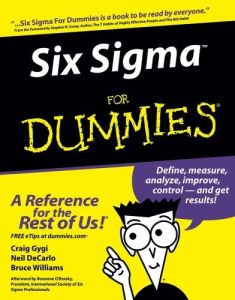
Craig Gygi, Neil DeCarlo and Bruce Williams
Six Sigma for Dummies
Define, measure, analyze, improve, control - and get results!
Wiley, 2005
What's inside?
Six Sigma pursues quality with methodical precision. It's statistical and tough – for dummies maybe, but not for sissies.


Summary availability: Worldwide
Recommendation
Authors Craig Gygi, Neil DeCarlo and Bruce Williams will attract both plaudits and brickbats for this book (no wonder they needed a foreword from Stephen Covey). Six Sigma, originally devised as a method for reducing production defects, has been elevated to a business cult whose jargon and methods are zealously guarded by a priesthood of consultants. This cadre is bound to regard skeptically any step toward making Six Sigma plain to the general business public. getAbstract recommends this manual because it successfully walks the tightrope between detailed technical analysis of Six Sigma methods and common sense terminology that is comprehensible to ordinary oxygen-breathers in the business world. Though it gets too heavy on statistics, it also avoids short cuts and fluffy Six Sigma-lite. The book does not delve into the recent trend toward using Six Sigma for carrying out change initiatives. However, given that its objective is to make professionals Six Sigma literate, this oversight is well within the acceptable range of variation.
Summary
About the Authors
Craig Gygi has helped teach and implement Six Sigma at several major corporations. He is a Master Black Belt and develops Six Sigma software. Neil DeCarlo learned Six Sigma at a Florida company that won the Deming Prize for quality. He has written or ghostwritten more than 150 articles and six books, and worked extensively with the original co-architect of Six Sigma, Dr. Mikel Harry. Bruce Williams first encountered Six Sigma at a Baldrige Award-winning company. As a member of the Hubble Telescope development project, he studied how small breakdowns lead to major failures. He founded two Six Sigma research and technology firms, and is CEO of a Six Sigma consulting firm.


Comment on this summary