getAbstract

Advanced Search
Blog Blog | RSS Feeds RSS Feeds | Free Free Summaries

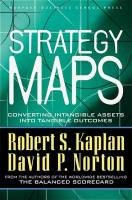
Strategy Maps

Converting Intangible Assets into Tangible Outcomes

by Robert S. Kaplan and David P. Norton

Harvard Business Press, 2004

Category: Strategy

Strategy Maps

Get the summary

Subscribe today and dramatically increase your business knowledge in your own time and at an affordable rate. Our summaries will update your skills, jump-start your career and put you ahead of the pack. Learn how to thrive in every aspect of your professional life.

Subscribe
Subscribe

Sign up now and receive immediate full access to this summary.

Free Sample Summaries
Free sample summaries

Get summaries of two business bestsellers.


getAbstract rating

Overall (?)

rating 9 (9)

Applicability

rating 9 (9)

Innovation

rating 10 (10)

Style

rating 7 (7)

Level of Expertise (?)

rating 9 (9)

User rating

(9.0)

In this summary you will learn

  • How to balance various forces that affect your organization: tangibles, intangibles, current profit and future innovation
  • How value-added strategies differentiate your firm and your products
  • How to create and implement a "strategy map" and achieve its goals
  • What the "Balanced Scorecard" method involves
  • How other companies have applied the strategy map concept

Why you should read Strategy Maps

If this book were a Hollywood film, it might be titled "Son of Balanced Scorecard" or even "Balanced Scorecard III." This book, however, is no mere spin-off or sequel. In two prior works, The Balanced Scorecard (which you may wish to read before reading this book) and The Strategy-Focused Organization, authors Robert S. Kaplan and David P. Norton introduced the powerful concept of measuring the elusive intangibles that affect organizations. This information-dense book was born when the authors observed that CEOs instinctively draw arrows to explain their goals. This led to a breakthrough realization: "Objectives should be linked in cause-and-effect relationships." The graphic display of these relationships is a "strategy map." This book breaks new ground by providing a template so executives can be sure that their strategic planning omits nothing. It expands the concepts of "strategic themes" and "value-creating processes," and explains a system for aligning your organization’s strategy with its intangible assets. However, the real-world examples may be lost on CEOs who are unfamiliar with MBA-style case studies. If you’re implementing a "Balanced Scorecard" initiative or planning your firm’s future, getAbstract.com says this is a blockbuster you don’t want to miss.

About the authors

Robert S. Kaplan is a professor of leadership development at Harvard Business School, and chairman of the Balanced Scorecard Collaborative, where David P. Norton is co-founder and president. Kaplan and Norton also co-authored The Balanced Scorecard and The Strategy-Focused Organization.

inivs
inivs
inivs
inivs
 
Welcome | How It Works | Browse | Corporate Solutions | Subscribe

Accessibility | Publishers | About Us | Careers | Press Corner | Testimonials | Shvoong | Bloomberg | Book Award | Gift Subscriptions | Contact | Blog

Disclaimer | Privacy Statement | Affiliate Program | Operating Agreement | © 1999-2010, getAbstract