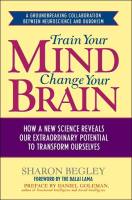
Train Your Mind, Change Your Brain
How a New Science Reveals Our Extraordinary Potential to Transform Ourselves
Category:
Concepts & Trends
Get the summary
Subscribe today and dramatically increase your business knowledge in your own time and at an affordable rate. Our summaries will update your skills, jump-start your career and put you ahead of the pack. Learn how to thrive in every aspect of your professional life.
In this summary you will learn
- How leading neuroscientists developed a radically new conception of the brain
- Why they now believe that brain cells remain teachable and replaceable
- How this advance can, literally, change your life
Why you should read Train Your Mind, Change Your Brain
For nearly a century, scientific dogma held that the brain is immutable, fixed by genes and early upbringing. Wall Street Journal science writer Sharon Begley recently visited the frontiers of neuroscience and returned with a news flash: The dogma is wrong. Researchers have discovered that the brain remains plastic, lifelong. This creates new frontiers: Stroke victims can rewire their brains using challenging exercises; deaf people can repurpose dormant auditory cortexes for other tasks; and blind people can begin to “see” patterns of Braille dots using a seemingly dead visual cortex. Suspecting that they were on to a general pattern, researchers soon looked for similar changes in “normal” brains. Working repetitively on your golf swing, playing the piano or learning a language, they found, also change your brain in lasting, important ways, as does practicing compassion toward others. Begley arrives with heavyweight friends: a foreword by the Dalai Lama and a preface by Daniel Goleman of Emotional Intelligence. If you want to understand how the brain keeps working, and how to make yours do more of what you want it to, getAbstract thinks you should start here. Your brain will thank you.
About the author
Sharon Begley is science columnist for The Wall Street Journal. She is the co-author of The Mind and the Brain: Neuroplasticity and the Power of Mental Force.

(9)
(8)
(2)

