

Navigation überspringen
Dealing with the Tough Stuff
Book

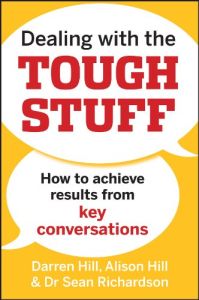
Dealing with the Tough Stuff

How to Achieve Results from Key Conversations

Wiley, 2012 Mehr

Buy the book


Editorial Rating

8

getAbstract Rating

  • Applicable

Recommendation

Behavioral scientist Darren Hill and psychologists Alison Hill and Sean Richardson explain that behaviors are difficult, but people aren’t, at least, not most people. To show leaders how to handle difficult workplace conversations, the authors discuss verbal and nonverbal communication, restructuring, termination, crisis management, and more. Their advice is succinct and to the point. They give managers the nitty-gritty on handling difficult behaviors without pop psychology fluff. Their practical suggestions include using three-point communication to defuse tense situations and cultivating a growth mind-set for handling crises. The authors lighten the mood with clever, alliterative chapter titles, while delivering tough, workable advice. You’ll appreciate the layout, charts, diagrams, brief examples and useful lists – all good stuff, and not just tough stuff. getAbstract recommends this perceptive book to managers, teachers, parents and other leaders.

Summary

“Foundational Skills”

Managers with staying power learn to tackle personnel problems head-on, but to do that, you have to be prepared. Ask yourself if you address misunderstandings immediately or ignore them. Are you aware of how nonverbal communication affects “tough” conversations? How well do you deal with anger? Can people manipulate you by being emotional? Are you confident in your ability to manage difficult, big-picture moments, such as layoffs or restructurings? How would you respond during a crisis? The answers to these questions can reveal where you must improve so you can manage tough discussions effectively.

To figure out why people behave as they do, use the “ABC model,” that is, consider the “Antecedents, Behavior” and “Consequences.” An antecedent is “what comes before” – what led to a problematic behavior. Behavior is what a person does. Consequences are events that result from behavior. Most behaviors have multiple antecedents and consequences. You can help your employees modify their behaviors once they understand what drives the way they act. People generally don’t change a behavior without a reason. For example, a hard worker who suddenly starts...

About the Authors

Behavioral scientist Darren Hill is a popular speaker in Australia and leads the Tough Stuff workshops. Blogger, trainer and consultant Alison Hill is a registered psychologist, as is Sean Richardson, a former world-class athlete who specializes in high performance psychology.


Comment on this summary

More on this topic

Related Skills

Anpassungsfähigkeit steigern
Eigenes Wohlbefinden stärken
Prospects konvertieren
Develop Team Members
Drive Team Performance
Innovationskultur fördern
Foster Team Culture
Personalwesen
Innovation
Ethisch führen
Strategisch führen
Gut leben
Unternehmenskommunikation managen
Manage Learning and Development
Performance managen
Risiken managen
Teams und Abteilungen managen
Management
Marketing
Zusammenarbeit meistern
Mitarbeiterleistung steigern
Persönliche Entwicklung
Strategisch planen
Diversity, Equity & Inclusion fördern
Vertrieb
Unternehmenskultur beeinflussen
Strengthen Team Collaboration
Organisationen verstehen
Berufliche Kompetenzen
Verletzlichkeit zeigen
Aktiv zuhören
Grenzen setzen
Öffentlich sprechen
Teamdynamik verstehen
Gewohnheiten entwickeln
Mitarbeiter entlassen
Mentale Gesundheit verbessern
Rapport mit Prospects aufbauen
Persönlich präsentieren
Growth Mindset entwickeln
Understand Organizational Behavior
Strategisch kommunizieren
Emotionen verstehen
Herausforderungen annehmen
Change managen
Work Remotely
Aufgaben delegieren
Positiv denken
Durch Change führen
Employee Experience verbessern
Servant Leadership praktizieren
Fragen stellen
Resilienter werden
Empathie und Mitgefühl zeigen
Disziplinarmaßnahmen umsetzen
Sich selbst verstehen
Practice Transformational Leadership
Kernwerte definieren
Sich selbst führen
Kommunikation im Team managen
Von unten führen
Motivation verstehen
Unsicherheit überwinden
Leistungsstandards definieren
Selbstwahrnehmung entwickeln
Transparent kommunizieren
Mitarbeitergespräche durchführen
Gespräche führen
Psychologische Sicherheit fördern
Kommunikation verstehen
Wirksam kommunizieren
Executive Leadership

Emotionale Intelligenz entwickeln
Emotionen regulieren
Führungswirkung steuern
Feedback geben
Konflikte lösen
Menschliches Verhalten verstehen
Business Continuity sicherstellen
Mitarbeiterbeziehungen managen
Herausforderungen überwinden
Diskussionen moderieren
Selbstbewusst auftreten
Kommunikationsstil anpassen
Führung
Krisenkommunikation steuern
Soziale Kompetenzen entwickeln
Mit schwierigen Menschen umgehen
Soft Skills
Navigate Leadership Challenges
Büropolitik meistern
Manage People and Talent
Krisen managen
Schwierige Gespräche führen
Soziale Signale erkennen
Klar kommunizieren
Durch Krisen führen

Nonverbal kommunizieren