Navigation überspringen
Go Put Your Strengths to Work
Book

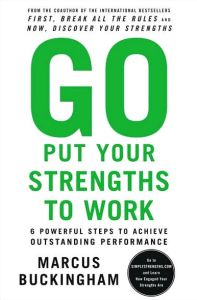
Go Put Your Strengths to Work

6 Powerful Steps to Achieve Outstanding Performance

Free Press, 2007 Mehr

Buy the book


Editorial Rating

7

getAbstract Rating

  • Innovative
  • Applicable
  • Eye Opening

Recommendation

Marcus Buckingham is passionate about helping you identify your unique strengths and unleash their power. As you read and work your way through the program in this book, you will become convinced that growing through your strengths is the ticket to your future happiness, effectiveness and success. He refutes the approach of improvement by fixing mistakes as a dead end that cannot help you discover how you can be exceptional. The book constantly refers you to its associated Web site for materials that will help you work through the exercises. Buckingham wants you to act rather than just read a theoretical tract. Nothing presented in this book will help you without action and implementation. However, if you take up the challenge, you will become empowered as you take charge of your work through your strengths. getAbstract recommends this book because it contains just a few simple ideas that could change your life.

Summary

Strengths and Mistakes

People make mistakes. The real question is whether you would do better by learning from those mistakes or by focusing on building your strengths instead. Do athletes perform better by filling their minds with images of winning or images of losing? Research says it is the former. Are your workdays filled with tasks that let your strengths flow? Does your work engage your very strongest abilities? Or do you spend your days managing your mistakes?

Recent research has explored two approaches toward business success, “Appreciative Inquiry” and “Positive Organizational Change.” Both have the same fundamental principle: Managing mistakes can help you limit the range of negative outcomes you might incur, but will not contribute to great success. However, if you study what works in your organization and build on it, you can expand your “positive deviance” – that is, the good side of being out of sync with the ordinary. You may consider deviance a negative factor, but it isn’t. It simply indicates that which is out of the norm.

You know that great feeling of accomplishment you get when you have used your best efforts to do a great piece of work? ...

About the Author

Marcus Buckingham is the author and co-author of several best-selling books including First, Break All the Rules; Now, Discover Your Strengths and The One Thing You Need to Know.



Comment on this summary

  • Avatar
  • Avatar
    A. T. 6 years ago
    Interesting
  • Avatar
    V. P. 1 decade ago
    It was a good summary on how best to think about priority of work, who owns the work, and whether or not the work distributed to the team should be re-distributed based on individual team members strengths
  • Avatar
    N. S. 1 decade ago
    Nice Book!!

More on this topic

Related Skills

Karriere voranbringen
Emotionale Intelligenz entwickeln
Selbstgesteuert lernen
Anpassungsfähigkeit steigern
Karriere
Innovationskultur fördern
Leads generieren und qualifizieren
Personalwesen
Innovation
Ethisch führen
Führung
Gut leben
Change managen
Management
Zusammenarbeit meistern
Soziale Kompetenzen entwickeln
Navigate Leadership Challenges
Vertriebsstrategie entwickeln
Diversity, Equity & Inclusion fördern
Vertrieb
Job suchen
Unternehmenskultur beeinflussen
Berufliche Kompetenzen
Eigenes Wohlbefinden stärken
Sich selbst motivieren
Achtsamkeit üben
Selbstvertrauen aufbauen
Personal Brand entwickeln
Diskussionen moderieren
Manage People and Talent
Zugehörigkeitsgefühl fördern
Develop Team Members
Work-Life-Balance finden
Mitarbeiterentwicklung unterstützen
Prokrastination vermeiden
Inklusiv führen
Besser denken
Soft Skills
Offene Kommunikation fördern
Mentale Gesundheit verbessern
Eigenen Purpose finden
Andere unterstützen
Herausforderungen annehmen
Führungswirkung steuern
Verantwortung übernehmen
Vertriebsteams managen
Von unten führen
Strengthen Team Collaboration
Andere beeinflussen
Teamgrenzen managen
Servant Leadership praktizieren
Verletzlichkeit zeigen
Karriere planen
Gewohnheiten entwickeln
Team motivieren
Persönliche Entwicklung
Practice Transformational Leadership
Durch Change führen
Durchhaltevermögen entwickeln
Drive Team Performance
Lerngewohnheit entwickeln
Produktiver werden
Selbstbeherrschung entwickeln
Eigenen Entwicklungsbedarf erkennen
Selbstdisziplin entwickeln
Psychologische Sicherheit fördern
Sinn finden
Teamagilität steigern
Herausforderungen überwinden
Talente strategisch einsetzen
Positive Fehlerkultur fördern
Selbstwahrnehmung entwickeln
Sich selbst verstehen
Resilienter werden
Positiv denken
Teamzusammenhalt stärken
Aus Fehlern lernen
Wandel von unten anstoßen
Foster Team Culture
Eigene Kompetenzen einschätzen
Sich selbst führen
Job Crafting praktizieren
Growth Mindset entwickeln
Eigene Stärken erkennen
Eigene Stärken einsetzen