Navigation überspringen
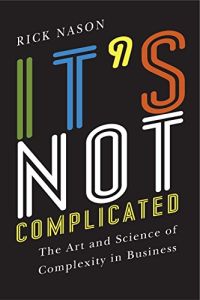
It’s Not Complicated
Book

It’s Not Complicated

The Art and Science of Complexity in Business

University of Toronto Press, 2017 Mehr

Buy the book


Editorial Rating

7

getAbstract Rating

  • Applicable
  • Concrete Examples

Recommendation

Drawing on systems thinking, professor Rick Nason encourages you to differentiate among “simple, complicated and complex” problems. He explains the “false axioms of business” and seven ongoing “paradigm shifts“ to help you understand how each type of problem requires a unique approach. Nason draws from economic theory, scientific management and behavioral research to offer a broad perspective on problem solving. At times you might feel a bit lost in this rather complicated – or complex? – approach to strategic thinking, but Nason cites business examples, both recent and historic, to help you connect the dots. getAbstract recommends his take on conquering the “complexity-thinking paradigm” to businesspeople and managers who may sometimes feel stuck in old ways of attacking hard problems.  

Summary

“Introduction to Systems and Complexity”

You can apply systems thinking to many fields, such as the natural sciences and engineering, to describe how things work and how to get tasks done. However, systems thinking is less known in the business world. Across fields, systems thinking differentiates among three kinds of tasks:

  • A simple task – Making coffee is a simple task because it is straightforward, it doesn’t require much skill training and it’s easy to determine if you’ve achieved the right result.
  • A complicated task – Preparing accounting statements is complicated because you need to be an expert who understands financial rules. Following these rules exactly produces a well-defined outcome. You can reproduce this outcome by giving the same task to another accountant who should come up with the same results.
  • A complex task – Giving a sales presentation differs from making coffee or preparing accounting statements because it doesn’t follow a prescribed, linear path to success. Each sales meeting is unique; results depend on positive interaction between you and the client. You...

About the Author

Rick Nason is an associate professor of finance in the Rowe School of Business at Dalhousie University in Halifax, Nova Scotia.



Comment on this summary

More on this topic

Related Skills

Unternehmen entwickeln
Zukunft der Arbeit
Projekte managen
Employee Experience verbessern
Foster Team Culture
Personalwesen
Kulturelles Bewusstsein entwickeln
Strategisch innovieren
Innovation
Operative Planung leiten
Gute Entscheidungen treffen
Change managen
Performance managen
Management
Zusammenarbeit meistern
Persönliche Entwicklung
Innovation verstehen
Berufliche Kompetenzen
Kreativität verstehen
Besser denken
Strategisch planen
Organisationen verstehen
Stress managen
In Unternehmenskultur zurechtfinden
Tech-Impact auf Arbeit
Durch Change führen
Work Remotely
Soziale Signale erkennen
Menschliches Verhalten verstehen
Mentale Gesundheit verbessern
Andere Perspektiven einnehmen
Persönlichkeitstypen verstehen
Mit schwierigen Menschen umgehen
Entrepreneurship
Führung
Compliance und Risiko steuern
Durchhaltevermögen entwickeln
Geschäftsmodelle entwerfen
Kreativ sein
Veränderungen annehmen
Soft Skills
Emotionen verstehen
Navigate Leadership Challenges
Unsicherheit überwinden
Sozialverhalten verstehen
Eigenes Wohlbefinden stärken
Unter Unsicherheit entscheiden
Manage People and Talent
Projektrisiken managen
Herausforderungen annehmen
Denken verstehen
Resilienter werden
Probleme lösen
Executive Leadership
Emotionen regulieren
Risiken managen
Gesellschaftliche Veränderungen verfolgen
Flexibel sein
Change verstehen
Emotionale Intelligenz entwickeln
Selbstwahrnehmung entwickeln
Anpassungsfähigkeit steigern
Growth Mindset entwickeln
Neue Führungsansätze
Strategisch führen
Sich selbst führen
Sich selbst verstehen
Büropolitik meistern
Herausforderungen überwinden
Strategisch denken
Ambidextrie nutzen
Soziale Kompetenzen entwickeln
Systemisch denken