Navigation überspringen
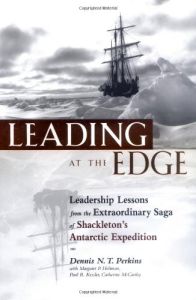
Leading at the Edge
Book

Leading at the Edge

Leadership Lessons from the Extraordinary Saga of Shackleton's Antarctic Expedition

AMACOM, 2000 Mehr

Buy the book


Editorial Rating

7

getAbstract Rating

  • Background
  • Engaging
  • Inspiring

Recommendation

When British explorer Sir Ernest Shackleton was busy saving his crew after a shipwreck in the Antarctic in 1914, you would guess that he wasn’t thinking much about teaching leadership lessons. But author Dennis N.T. Perkins uses Shackleton’s expedition to show how the leadership principles the explorer exercised can be applied to your work. He even adds modern case studies as illustration. This excellent book is at its best when it describes Shackleton’s courageous rescue. He led his men to safety through a frozen wilderness by focusing on the ultimate goal of survival, setting a personal example, overcoming conflict, minimizing status differences, stressing teamwork and applying other essential leadership qualities. Though the principles may sound familiar, the book provides a dramatic new view of them, and it is written in a clear, crisp style. getabstract recommends it to all corporate explorers.

Summary

Shackleton’s 10 Leadership Principles

In 1913 and 1914, two expeditions set out to explore frozen wildernesses. Canadian anthropologist Vilhjalmur Stefansson sailed in the Karluk to explore northern Canada, while Sir Ernest Shackleton sailed on the Endurance from the island of South Georgia to attempt the first overland crossing of Antarctica. Both ships soon were trapped in pack ice, but the expeditions had very different outcomes. Stefansson’s crew disintegrated into a group of self-interested individuals who resorted to lying, cheating and theft to further their personal survival, and 11 of them died. By contrast, the crew of the Endurance worked together as a team under Shackleton’s leadership and all survived, despite tremendous hardship.

Shackleton followed these 10 key leadership principles:

  1. Always keep the ultimate goal in mind, while you focus energy on short-term goals.
  2. Use visible and memorable symbols and behaviors to set a personal example.
  3. Inspire others to feel optimistic and self-confident, yet stay in touch with reality.
  4. Stay strong; don’t feel guilty about taking care...

About the Authors

Dennis N. T. Perkins, Ph.D.  is President of the Syncretics Group, a consulting organization serving large corporate clients and focusing on effective leadership in demanding environments. He has a B.S. from the U.S. Naval Academy, an M.B.A. from Harvard University and a Ph.D. from the University of Michigan. Margaret P. Holtman  is director of employee development at Hartford Life. Paul R. Kessler is a managing consultant at Stromberg Consulting. Catherine McCarthy, Ph.D. , is a consultant with Organizational Psychologists.



Comment on this summary

More on this topic

Related Skills

Emotionale Intelligenz entwickeln
Anpassungsfähigkeit steigern
Eigenes Wohlbefinden stärken
Wirksam kommunizieren
Digitale Transformation
Enhance Cybersecurity
Innovationskultur fördern
Personalwesen
Innovation
Ethisch führen
Gut leben
Gute Entscheidungen treffen
Unternehmenskommunikation managen
Management
Marketing
Persönliche Entwicklung
Vertriebsstrategie entwickeln
Diversity, Equity & Inclusion fördern
Vertrieb
Unternehmenskultur beeinflussen
Digitalkompetenz aufbauen
Berufliche Kompetenzen
Flexibel sein
Transparent kommunizieren
Diskussionen moderieren
Build Security Culture
Inklusiv führen
Projekte managen
Durch Krisen führen
Resilienter werden
Durch Change führen
Herausforderungen überwinden
Zusammenarbeit meistern
Empathie und Mitgefühl zeigen
Teams und Abteilungen managen
Virtuell zusammenarbeiten
Durchhaltevermögen entwickeln
Teamgrenzen managen
Positiv denken
Psychologische Sicherheit fördern
Herausforderungen annehmen
Vertriebsteams managen
Team motivieren
Navigate Leadership Challenges
Verletzlichkeit zeigen
Executive Leadership
Probleme lösen
Drive Team Performance
Büropolitik meistern
Demut üben
Gruppenentscheidungen treffen
Ideenfindung moderieren
Kommunikation im Team managen
Soziale Kompetenzen entwickeln
Authentisch sein
Sich selbst führen
Offene Kommunikation fördern
Selbstfürsorge praktizieren
Teamdynamik verstehen
Change managen
Humor einsetzen
Soft Skills
Führung
Unternehmens-Purpose kommunizieren
Gemeinsame Vision definieren
Strengthen Team Collaboration
Funktionsübergreifend zusammenarbeiten
Practice Transformational Leadership
Servant Leadership praktizieren
Manage People and Talent
Zugehörigkeitsgefühl fördern
Schwierige Gespräche führen
Mitarbeiterbeziehungen managen
Teamzusammenhalt stärken
Mit schwierigen Menschen umgehen
Foster Team Culture
Konflikte lösen