
Navigation überspringen
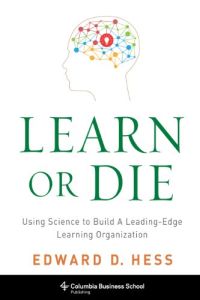
Learn or Die
Book

Learn or Die

Using Science to Build a Leading-Edge Learning Organization

Columbia UP, 2014 Mehr

Buy the book


Editorial Rating

8

getAbstract Rating

  • Applicable

Recommendation

Professor Edward D. Hess offers a clear, methodical synthesis of current research. If you are familiar with the fields of learning and thinking, or with learning organizations, you’ll recognize much of this intelligently compiled content. However, you’ll still learn from reading Hess’s clear, methodical overview, which works as a manual for applying today’s research to yourself and your firm. While focusing on core concepts and tools, Hess also offers usefully honest accounts of his personal experiences and the transformations people go through to become better learners. His case studies are fascinating. getAbstract recommends Hess’s work to teachers, managers, innovators and anyone interested in learning organizations.

Summary

Creating a “High-Performance Learning Organization”

Excellence and innovation require constant learning as an individual and as part of a learning organization. Peter M. Senge’s The Fifth Discipline popularized learning organizations in 1990. Since then, “the science of learning” has made great strides. New approaches draw on education, psychology and neuroscience to integrate studies of change and performance. These methods can help your firm become a high-performance learning organization (HPLO).

Learning calls for evaluating the “relationships between stimuli and their effects.” For example, you learn what happens when you take certain actions by observing the results. Then you build context through time and repetition. You link your observations together by creating narratives and developing structured, categorizing systems. These systems or processes eventually function automatically, like an operating system. Your internal operating system works subconsciously, and shapes your perceptions and emotions.

To learn better, you need to understand your system, so you can change and improve it. In Thinking Fast and Slow, Daniel Kahneman identified...

About the Author

Edward D. Hess, the Batten executive-in-residence at the University of Virginia Darden Graduate School of Business, also wrote Smart Growth and 10 other books.



Comment on this summary

  • Avatar
  • Avatar
    A. 7 years ago
    Great synopsis of an interesting book. A good chance to slow down in our fast environment and a implicit call to CHANGE
  • Avatar
    W. H. 1 decade ago
    great book and worth sharing to my leaders... Its good to pause and be rational over our erratic or critical decisions...
  • Avatar
    P. S. 1 decade ago
    How very apprporate to a learning organization. The title is so relevant!!

More on this topic

Related Skills

AI Transformation
Kreativ sein
Emotionale Intelligenz entwickeln
Anpassungsfähigkeit steigern
Wirksam kommunizieren
Develop Team Members
Unternehmen entwickeln
Digitale Transformation
Enable Digital Organization
Executive Leadership
Foster Team Culture
Personalwesen
Strategisch innovieren
Innovation
Ethisch führen
Strategisch führen
Leverage AI for HR
Leverage AI for Leadership
Leverage AI in Your Daily Tasks
Management
Soziale Kompetenzen entwickeln
Persönliche Entwicklung
Soft Skills
Innovation verstehen
Organisationen verstehen
Berufliche Kompetenzen
Führungskräfte entwickeln
Use AI for Coaching and Development
Ambidextrie nutzen
Manage People and Talent
Annahmen hinterfragen
Menschen coachen
Unternehmenskultur beeinflussen
Selbstbeherrschung entwickeln
L&D-Technologie nutzen
Employee Experience verbessern
Experimentieren fördern
Innovationskultur fördern
Datenbasierte Entscheidungen treffen
Denken verstehen
Verletzlichkeit zeigen
Unternehmensperformance steigern
Führungswirkung steuern
Lebenslang lernen
Andere Perspektiven einnehmen
Build Digital Culture
Fragen stellen
Aus Erfahrung lernen
Manage Learning and Development
Use AI for Learning & Development
Besser denken
Use AI for Learning and Upskilling
Sich selbst verstehen
Learning Experiences gestalten
Sich selbst führen
Psychologische Sicherheit fördern
Servant Leadership praktizieren
Führung
Neugierig sein
Wissenschaftlich denken
Social Learning nutzen
Logisch denken
Selbstwahrnehmung entwickeln
Unter Unsicherheit entscheiden
Lernen verstehen
Gute Entscheidungen treffen
Lernkultur schaffen
Lerngewohnheit entwickeln
Growth Mindset entwickeln
Selbstgesteuert lernen
Denkfehler vermeiden
Kritisch denken
Betriebliches Lernen verstehen