
Navigation überspringen
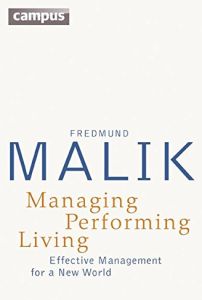
Managing Performing Living
Book

Managing Performing Living

Effective Management for a New World

Campus, 2015
First Edition: 2015 Mehr

Buy the book


Editorial Rating

9

getAbstract Rating

  • Applicable
  • Eye Opening

Recommendation

Fredmund Malik, an Austrian management expert, eviscerates much of common practice in large corporations without seeming angry, just a bit cantankerous. Malik’s take on meetings? Get rid of them. Performance reviews? Twaddle. Managers’ pep talks aimed at building enthusiasm? Don’t waste your time. Malik pokes holes in conventional wisdom and offers actionable, commonsense alternatives. Managers who’d like to rethink ordinary practices will relish his guide. The original edition, published in German, is a management classic.

Summary

Too often, managers emphasize workers’ weaknesses. To be an effective manager, focus on employees’ strengths.

Too often, managers emphasize workers’ weaknesses. Human resources managers  identify weaknesses that lead to mistakes and subpar performance, and teach workers to overcome them. Weaknesses are easy to find but hard to eliminate. To be an effective manager, stop complaining about employees’ shortcomings and trying to fix their flaws. Focus on their strengths. Assign people to tasks they’re good at, and they’ll do a great job. Few people are multitalented. The greats of music, the arts and athletics had talent primarily in one arena. 

An effective boss identifies employees’ weaknesses only in order to assess what sort of assignments to avoid. Find a worker’s wheelhouse, and keep the employee focused on tasks in that zone of excellence. A track coach wouldn’t put a slow runner in a sprint or a sprinter in a long-distance slog. The coach assesses each athlete’s strengths and weaknesses, steers the athlete toward a suitable event and provides training. Direct your staffers toward...

About the Author

Fredmund Malik is one of Europe’s top experts on management, leadership and corporate governance. He is the founder of an institution carrying his name. 


Comment on this summary

  • Avatar
  • Avatar
    A. P. 5 years ago
    Great book. Nice summary. BUT: The German summary is much better & closer to the book.
    I was looking for the "Tasks of the Manager" - these are missing here, but are in the German version. Any chance of updating this summary to include what the non-German speakers are missing out?
    • Avatar
      5 years ago
      Hello Andrew, thank you for your comment. We have taken your suggestion and updated the summary. I have sent you the updated version via email.
  • Avatar
    E. D. 8 years ago
    This book is a keeper. It is something I will refer to again and again.
  • Avatar
    H. M. 8 years ago
    One of the best ‘read over and over again’ books. A guide to follow.

More on this topic

Related Skills

Karriere voranbringen
AI Transformation
Eigenes Wohlbefinden stärken
Selbstvertrauen aufbauen
Karriere
Unternehmensfinanzen
Develop Team Members
Investitionen und M&A managen
Drive Team Performance
Foster Team Culture
Personalwesen
Ethisch führen
Operative Planung leiten
Strategisch führen
Leverage AI in Your Daily Tasks
Teams und Abteilungen managen
Zusammenarbeit meistern
Persönliche Entwicklung
Talente strategisch einsetzen
Vertriebsstrategie entwickeln
Vertrieb
Soft Skills
Strengthen Team Collaboration
Führungskräfte entwickeln
Investment-Portfolio verwalten
Von unten führen
Mitarbeiterleistung steigern
KPIs festlegen und nachverfolgen
Prokrastination vermeiden
Rollen definieren
Strategie umsetzen
Selbstbeherrschung entwickeln
Use AI for Meetings
Arbeitsabläufe straffen
Leverage AI for Management
Achtsamkeit üben
Projekte planen und umsetzen
Leistungsstandards definieren
Vertriebsteams managen
Menschen coachen
Talentmanagement betreiben
Organisationen verstehen
Sich selbst führen
Performance managen
Servant Leadership praktizieren
Manage People and Talent
Practice Transformational Leadership
Ideenfindung moderieren
Führung
Führungsansätze verstehen
Job Crafting praktizieren
Mentor sein
Selbstdisziplin entwickeln
Ziele setzen und erreichen
Mitarbeiter beurteilen
Unternehmensperformance steigern
Projekte managen
Executive Leadership
Berufliche Kompetenzen
Mitarbeitergespräche durchführen
Aufgaben delegieren
Eigene Stärken einsetzen
Produktiver werden
Zeit managen
Management
Meetings wirksam gestalten