
Navigation überspringen
Managing the Millennials
Book

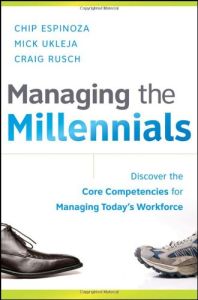
Managing the Millennials

Discover the Core Competencies for Managing Today's Workforce

Wiley, 2010 Mehr

Buy the book


Editorial Rating

7

getAbstract Rating

  • Concrete Examples
  • For Beginners

Recommendation

Those difficult 20-somethings in your workforce address the CEO by first name, talk out of turn in meetings, and show up late but gladly pull all-nighters. They bristle at your suggestions but thrive on complex challenges. They’re special – that’s what their parents and teachers always told them. They’re the Millennials, complex, multitasking, technologically savvy, exasperating, bright but entitled new employees entering the workforce by the millions. Consultants and professors Chip Espinoza, Mick Ukleja and Craig Rusch offer tactics and strategies for managers confused by this unpredictable generation. Though the authors don’t mind painting this or any other generations with a very broad brush, they still present much useful advice. getAbstract suggests throwing out the rule book and adopting the authors’ nine strategies for getting the most out of your youngest workers.

Summary

Generation Traits and Gaps

Millennials form the “most educated and technologically savvy generation ever.” Their parents sheltered them and gave their lives structure. The US workforce now includes 31 million Millennials, and that number will increase steadily in the next five years. When people of the same age experience high-impact events, they develop a similar mind-set that shapes lifelong perspectives and values.

People born between 1925 and 1945 form the Builders generation and were shaped by The Great Depression, Roosevelt’s presidency, World War II and its aftermath. They respect authority, value a strong work ethic and expect to wait for rewards. Builders often worked for one company their entire careers.

Following the Builders came the Baby Boomers, the more than 80 million Americans born between 1946 and 1964. They experienced the emergence of television and rock and roll, the Vietnam conflict, the civil rights and the women’s movements. For Boomers, work is about accumulating material wealth and creating a professional identity.

Arriving between 1965 and 1977, Generation Xers – 38 million strong – bridge Baby Boomers and Millennials. They grew...

About the Authors

Chip Espinoza teaches leadership seminars and heads GeNext Consulting. Mick Ukleja is founder and president of LeadershipTraQ. Craig Rusch teaches anthropology at Vanguard University in California.


Comment on this summary

  • Avatar
  • Avatar
    J. H. 1 decade ago
    Great summary with some very good insight to how to lead a team of millennials! Get on board quickly or get run over.
  • Avatar
    W. G. 1 decade ago
    This book opens your eyes to the differences in personality and work ethics or the different generations. There is definitely a difference in management styles for the different generations. The Millennial do not need as much direction as the baby boomers. However, they are not as social in the team environments.
  • Avatar
    J. P. 1 decade ago
    I realize that this is a summary of a generalization about millennials, but I feel it is saying that millennials are people we hire to be our children at work. Fortunately, the millennials I work with exhibit the positive attributes expressed in the summary and not the negatives. It's interesting that in one of the other summaries for this month, Managing the Older Employee, Gen Xers are described in much the same way as millennials are in this summary. The other book was written in 2006 and this one in 2010. Interesting how focus has moved from one generation to the next in just a few years, but the views are similar.

More on this topic

Related Skills

Karriere voranbringen
Emotionale Intelligenz entwickeln
Eigenes Wohlbefinden stärken
Karriere
Wirksam kommunizieren
Innovative Produkte entwickeln
Develop Team Members
Unternehmen entwickeln
Drive Team Performance
Employee Experience verbessern
Entrepreneurship
Foster Team Culture
Personalwesen
Kulturelles Bewusstsein entwickeln
Strategisch innovieren
Ethisch führen
Sich selbst führen
Gut leben
Manage Learning and Development
Vergütung managen
Management
Soziale Kompetenzen entwickeln
Persönliche Entwicklung
Diversity, Equity & Inclusion fördern
Unternehmenskultur beeinflussen
Strengthen Team Collaboration
Innovation verstehen
Berufliche Kompetenzen
Work-Life-Balance finden
Practice Transformational Leadership
Lernkultur schaffen
Mikroaggressionen verstehen
Sinn finden
Andere Perspektiven einnehmen
Growth Mindset entwickeln
Mentee sein
Ambidextrie nutzen
Emotionen regulieren
Servant Leadership praktizieren
Manage People and Talent
Feedback geben
Neue Ideen vorantreiben
Besser denken
Experimentieren fördern
Psychologische Sicherheit fördern
Neugierig sein
Mit schwierigen Menschen umgehen
Schwierige Gespräche führen
Generationenvielfalt fördern
Flexibel sein
Soft Skills
Führung
Mitarbeiterbeiträge belohnen
Ideen entwickeln
Motivation verstehen
Veränderungen annehmen
Kreativität verstehen
Mentor sein
Anreizsysteme gestalten
Anpassungsfähigkeit steigern
Gut altern
Divergent denken
Ideenfindung moderieren
Flexible Arbeitszeitmodelle anbieten
Kreativ zusammenarbeiten
Innovation
Innovationskultur fördern
Kreativ sein
Kreativität fördern