
Navigation überspringen
Principle-Centered Leadership
Book

Principle-Centered Leadership

Simon & Schuster, 1990 Mehr

Buy the book


Editorial Rating

9

getAbstract Rating

  • Innovative
  • Applicable

Recommendation

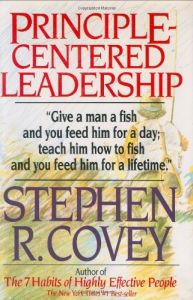
Stephen R. Covey shows how you can become a principle-centered leader, and how you can use principle-centered leadership philosophies to more effectively manage people. Principle-centered power is created when the values of the follower and leader overlap. Control is apparent, but it is not external; it is self-control. It elicits a willingness to risk doing the right things because they are valued and modelled by the leader. People follow the leader because of who he or she is. This book is full of lists, charts, diagrams and anecdotal examples to help the reader fully comprehend the ideas contained within. The cover of the book has the famous quote, "Give a man a fish and you feed him for a day; teach a man to fish and you feed him for a lifetime." This quote encapsulates the intentions of the book. Covey wants to teach you how to fish. And he wants you to know it’s not as simple as picking a lure and casting. Good fishermen learn through years of applying their skills. Managers become good managers through years of applying principle-centered leadership. getAbstract recommends the book to managers and executives at all levels.

Summary

Characteristics of Principle-Centered Leaders

Principle-centered leadership begins with yourself and spreads out toward those you lead. There are many management techniques and tricks you can use to achieve some short-term benefits, but without strong principle-centered leadership your staff will become cynical towards each new quick-fix solution.

There are eight characteristics of principle-centered leaders. Strive to make these eight characteristics reflective of your own leadership style.

Characteristic One: Learn continually.

Educate yourself through experience. Read, seek training, take classes, listen to others and learn with both your ears and eyes. Discover that the more you know, the more you don’t know. As your circle of knowledge expands, so does your outside edge of ignorance.

Characteristic Two: Be service-oriented.

See life as a mission, not as a career. Every morning “yoke up” and put on the harness of service. Any effort to become principle-centered as an intellectual exercise will fail. You need to have a sense of responsibility and activity.

Characteristic Three: Radiate positive energy.

Be cheerful, pleasant...

About the Author

Stephen R. Covey  is an internationally respected leadership authority, teacher, organizational consultant, founder of the former Covey Leadership Center, and co-chairman of Franklin Covey Co. He has made teaching Principle-Centered Living and Principle-Centered Leadership his life’s work. He holds an M.B.A. from Harvard and a doctorate from Brigham Young University. He has been recognized as one of Time magazine’s twenty-five most influential Americans. His other bestsellers are The 7 Habits of Highly Effective People and First Things First.



Comment on this summary

More on this topic

Related Skills

Emotionale Intelligenz entwickeln
Anpassungsfähigkeit steigern
Selbstvertrauen aufbauen
Prospects konvertieren
Innovationskultur fördern
Personalwesen
Innovation
Ethisch führen
Strategisch führen
Gut leben
Unternehmenskommunikation managen
Management
Marketing
Persönliche Entwicklung
Diversity, Equity & Inclusion fördern
Vertrieb
Unternehmenskultur beeinflussen
Berufliche Kompetenzen
Nonverbal kommunizieren
Sinn finden
Vertrauen gewinnen
Krisenkommunikation steuern
Manage People and Talent
Mit Stakeholdern kommunizieren
Eigenverantwortung fördern
Navigate Leadership Challenges
Eigenes Wohlbefinden stärken
Work-Life-Balance finden
Unsicherheit überwinden
Authentisch sein
Rapport mit Prospects aufbauen
Executive Leadership
Büropolitik meistern
Sich selbst verstehen
Führungswirkung steuern
Practice Transformational Leadership
Empathie und Mitgefühl zeigen
Verletzlichkeit zeigen
Mit schwierigen Menschen umgehen
Emotionen regulieren
Von unten führen
Soft Skills
Leben aktiv gestalten
Offene Kommunikation fördern
Demut üben
Gespräche führen
Foster Team Culture
Selbstdisziplin entwickeln
Herausforderungen annehmen
Führung
Soziale Kompetenzen entwickeln
Selbstwahrnehmung entwickeln
Aktiv zuhören
Kommunikationsstil anpassen
Eigenen Purpose finden
Drive Team Performance
Eigene Stärken einsetzen
Selbstbeherrschung entwickeln
Servant Leadership praktizieren
Verantwortung übernehmen
Interkulturell kommunizieren
Kernwerte definieren
Sich selbst führen
Andere beeinflussen
Psychologische Sicherheit fördern
Zusammenarbeit meistern
Lebenslang lernen
Strengthen Team Collaboration
Selbstfürsorge praktizieren
Aus Fehlern lernen
Transparent kommunizieren
Coachbar sein
Selbstgesteuert lernen
Selbstbewusst auftreten
Wirksam überzeugen
Growth Mindset entwickeln
Kommunikation im Team managen
Andere unterstützen
Neugierig sein
Strategisch kommunizieren
Klar kommunizieren
Kommunikation verstehen
Schwierige Gespräche führen
Lerngewohnheit entwickeln
Wirksam kommunizieren