Navigation überspringen
The 10 Laws of Trust
Book

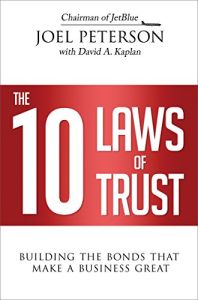
The 10 Laws of Trust

Building the Bonds That Make a Business Great

AMACOM, 2016 Mehr

Buy the book


Editorial Rating

8

getAbstract Rating

  • Applicable

Recommendation

In an interdependent world, progress requires trust. If you can’t trust others, you cannot work toward shared goals. This is true for families, couples, team members and the nations of the world. JetBlue chairman Joel Peterson, writing with David A. Kaplan, details “10 laws of trust.” He explains what trust means, how to promote it inside organizations and how to restore trust when it’s damaged. Peterson addresses the “Valentine’s Day Massacre” of interrupted service that JetBlue suffered in 2007 – and how the company healed the resulting breach of trust with its customers – but he doesn’t explore any more recent difficulties that the airline has experienced. Nonetheless, getAbstract recommends his concise, readable, ethical guide to all who must trust others or earn trust. And that’s everybody.

Summary

Trust Equals Faith

Trust is a basic requirement for all human activity. Trust connotes optimism. To demonstrate trust, you must show faith in someone or something else. That requires ceding control of an aspect of your life to another person, institution or organization. Trust implies voluntary vulnerability. Trust means taking risks, often before you have proof of reciprocity.

Trust implies “enlightened self-interest.” Trust is the social lubricant that eliminates friction. Trust is reciprocal: If you trust people, they usually trust you in return. When trust disappears, interactions break down. With one act of deceit, trust can vanish, often forever.

In most cases, trusting others turns out to be a good bet. Trust enables productive teamwork and cooperation. Protocols, procedures and compliance manuals are of little value in the absence of trust, and suspicions, paranoia and cynicism abound. Trust is vital in today’s peer-to-peer economy, with people increasingly sharing such resources as “cars, boats and apartments.”

Trust doesn’t just happen. It depends on active initiation. People must earn trust. Employees in “high-trust” organizations work together...

About the Author

Joel Peterson, chairman of JetBlue, is a consulting professor at the Stanford Graduate School of Business. New York Times best-selling author David A. Kaplan teaches journalism and law at New York University.


Comment on this summary

More on this topic

Related Skills

AI Transformation
Emotionale Intelligenz entwickeln
Wirksam kommunizieren
Prospects konvertieren
Businessplan entwickeln
Innovative Produkte entwickeln
Develop Team Members
Drive Team Performance
Entrepreneurship
Personalwesen
Leverage AI for Leadership
Unternehmenskommunikation managen
Performance managen
Teams und Abteilungen managen
Management
Marketing
Zusammenarbeit meistern
Navigate Leadership Challenges
Mitarbeiterleistung steigern
Persönliche Entwicklung
Strategisch planen
Diversity, Equity & Inclusion fördern
Vertrieb
Unternehmenskultur beeinflussen
Strengthen Team Collaboration
Berufliche Kompetenzen
Unternehmenskultur verstehen
Unternehmens-Purpose kommunizieren
Foster Team Culture
Führungswirkung steuern
Andere Perspektiven einnehmen
Ethik verstehen
Mit schwierigen Menschen umgehen
Mitarbeiterbeziehungen managen
Gender-Inklusion fördern
Psychologische Sicherheit fördern
Soft Skills
Konflikte lösen
Teamziele setzen
Kernwerte definieren
Team motivieren
Generationenvielfalt fördern
Soziale Kompetenzen entwickeln
Use AI Ethically as a Leader
Kreativ sein
Leistungsstandards definieren
Positive Fehlerkultur fördern
Empathie und Mitgefühl zeigen
Zugehörigkeitsgefühl fördern
Diskussionen moderieren
Persönliche Reputation managen
Sich selbst führen
Fragen stellen
Aufgaben delegieren
Führung
Inklusive Kultur schaffen
Neue Ideen vorantreiben
Inklusiv führen
Kreativität fördern
Andere beeinflussen
Schwierige Gespräche führen
Büropolitik meistern
Practice Transformational Leadership
Purpose, Vision und Mission definieren
Verletzlichkeit zeigen
Kreativ zusammenarbeiten
Annahmen hinterfragen
Verhandeln
Eigenverantwortung fördern
Executive Leadership
Vertrauen gewinnen
Ethisch handeln
Verantwortung übernehmen
Innovationskultur fördern
Innovation
Experimentieren fördern
Ideenfindung moderieren
Demut üben
Servant Leadership praktizieren
Divergent denken
Gemeinsame Vision definieren
Ethisch führen
Accountability sicherstellen
Transparent kommunizieren
Authentisch sein