
Navigation überspringen
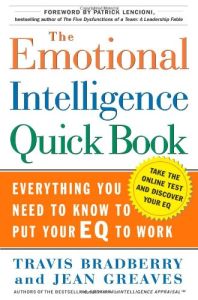
The Emotional Intelligence Quick Book
Book

The Emotional Intelligence Quick Book

Everything You Need to Know to Put Your EQ to Work

Touchstone, 2005 Mehr

Buy the book


Editorial Rating

9

getAbstract Rating

  • Innovative
  • Applicable

Recommendation

If you had to select the person you think is “most likely to succeed,” how would you go about making your choice? According to authors Travis Bradberry and Jean Greaves, you’d miss the mark if you based your choice on educational achievement, intelligence or experience. The main criteria, instead, is a set of social skills known as “emotional intelligence” (EQ) that helps people interact effectively. When you’re emotionally intelligent, your emotions work for – not against – you, and you are respectful and mindful of other peoples’ feelings. Even the most emotionally challenged people can boost their “EQs” by practicing the skills this book outlines. It offers specific examples of how to bring emotional intelligence to bear in a variety of situations at home and at work. getAbstract recommends this book to those who want to use emotional intelligence effectively.

Summary

The Emotion-Reason Connection in Your Brain

In 1848 – thanks to an unusual, grisly accident that befell a good-natured, popular railroad foreman named Phineas Gage – scientists discovered that specific areas of your brain control how you get along with people. When Gage was laying railroad tracks, his assistant got distracted and didn’t take the usual safety measures, thus causing a freak accident – an explosion of gunpowder that blew a heavy, long iron rod through Gage’s forehead. Although he survived, the flying rod removed the front portion of his brain, and Gage lost the ability to moderate his temper or impulses. Though he could still do calculations and function in his job, his life changed dramatically for the worse. Now cranky and erratic, he lashed out at the mildest provocation, appeared irrationally unable to get a grip on his emotions and no longer got along well with his co-workers. As science now knows, the ability to manage your emotions requires effective biological “wiring” between the reasoning and feeling areas of the brain, and Gage had lost that link.

People are emotional creatures, so always be mindful of the role emotions play in your behavior...

About the Authors

Travis Bradberry and Jean Greaves are co-founders of an EQ training company, and experts in industrial-organizational psychology.


Comment on this summary

  • Avatar
  • Avatar
    S. K. 11 months ago
    Short yet very good to read.
  • Avatar
    P. A. 1 year ago
    Thank you. That was indeed awesome to read. Made a lot of sense.
  • Avatar
    R. P. 3 years ago
    This is excellent learn

More on this topic

Related Skills

Anpassungsfähigkeit steigern
Prospects konvertieren
Drive Team Performance
Employee Experience verbessern
Innovationskultur fördern
Personalwesen
Innovation
Ethisch führen
Gut leben
Performance managen
Management
Zusammenarbeit meistern
Persönliche Entwicklung
Diversity, Equity & Inclusion fördern
Vertrieb
Berufliche Kompetenzen
Kulturelles Bewusstsein entwickeln
Inklusiv führen
Konflikte lösen
Starke Beziehungen aufbauen
Herausforderungen annehmen
Herausforderungen überwinden
Öffentlich sprechen
Navigate Leadership Challenges
Soft Skills
Empathie und Mitgefühl zeigen
Führung
Diskussionen moderieren
Führungswirkung steuern
Zugehörigkeitsgefühl fördern
Mentale Gesundheit verbessern
Eigenes Wohlbefinden stärken
Teamagilität steigern
Servant Leadership praktizieren
Resilienter werden
Elternrolle meistern
Selbstbeherrschung entwickeln
Sich selbst führen
Menschliches Verhalten verstehen
Soziale Kompetenzen entwickeln
Strengthen Team Collaboration
Teamzusammenhalt stärken
Andere unterstützen
Persönlichkeitstypen verstehen
Rapport mit Prospects aufbauen
Foster Team Culture
Mitarbeiterbeziehungen managen
Mit schwierigen Menschen umgehen
Emotionen verstehen
Selbstwahrnehmung entwickeln
Verletzlichkeit zeigen
Aktiv zuhören
Emotionale Intelligenz entwickeln
Schwierige Gespräche führen
Soziale Signale erkennen
Sozialverhalten verstehen
Selbstbewusst auftreten
Kommunikation verstehen
Emotionen regulieren
Team motivieren
Sich selbst verstehen
Nonverbal kommunizieren
Büropolitik meistern
Manage People and Talent
Gespräche führen
Wirksam kommunizieren
Psychologische Sicherheit fördern
Teamdynamik verstehen