Melden Sie sich bei getAbstract an, um die Zusammenfassung zu erhalten.

What Works

Melden Sie sich bei getAbstract an, um die Zusammenfassung zu erhalten.
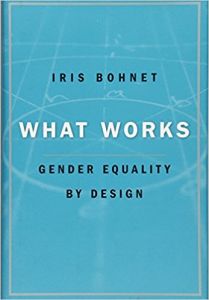
What Works

Gender Equality by Design

Belknap Press,

15 Minuten Lesezeit
10 Take-aways
Audio & Text

Was ist drin?

Harvard professor Iris Bohnet analyzes why some efforts to build gender equality work – and why some don’t.

Editorial Rating

9

getAbstract Rating

  • Analytical
  • Overview
  • Concrete Examples

Recommendation

Harvard professor Iris Bohnet seeks to determine “what works” when it comes to increasing gender equality. In that pursuit, she offers a focused, meticulous review of efforts to change human behavior to foster inclusion and ethical practice. Bohnet analyzes surveys, lab studies, corporate actions, meta studies and the law from a broad array of disciplines: politics, business, social science, gender studies, and more. The result can be overwhelming, but her prose is always engaging and useful. The author is exceptionally honest. She flatly states how ineffective certain well-intended programs have been. This clarifies her ethical commitment and makes her conclusions more persuasive. getAbstract recommends Bohnet’s insight to anyone interested in clear thinking, social science and a more inclusive society.

Summary

Why “Behavioral Design”

In 1970, only 5% of the performers in the five best American orchestras were female. Now more than 35% are. This didn’t happen by accident. Following the lead of the Boston Symphony, orchestras shifted to blind auditions, wherein judges hear musicians play but don’t see them. Directors always believed they cared only about a musician’s skill. “Unconscious” bias led them to select a majority of men. When they auditioned musicians behind a screen, they chose differently.

Increased gender equality would benefit society. For instance, equality expands the talent pool: Consider how many fine musicians weren’t hired before the advent of blind auditions. When societies exclude women from the workforce, per capita income drops 40%. Yet, some efforts to increase diversity have failed or have had negative effects. Seeing what works requires experimentation.

Unconscious Bias

Unconscious bias is omnipresent and hard to unlearn; it distorts people’s thinking and their perceptions. People expect different things from men and from women in the workplace.

But as employees struggle to put biases aside, behavioral...

About the Author

A native of Switzerland, Iris Bohnet, PhD, is a behavioral economist at Harvard University. She is a professor, the director of the Women and Public Policy Program, and co-chair of the Behavioral Insights Group at the Kennedy School of Government.


Comment on this summary

  • Avatar
  • Avatar
    M. B. 3 years ago
    Great insights for a more inclusive society
  • Avatar
    E. Z. 3 years ago
    thanks for this recomendation
  • Avatar
    L. E. 5 years ago
    Interesting read

More on this topic

Related Skills

Karriere voranbringen
AI Transformation
Talente gewinnen
Kreativ sein
Emotionale Intelligenz entwickeln
Karriere
Wirksam kommunizieren
Innovative Produkte entwickeln
Besser denken
Zukunft der Arbeit
Entrepreneurship
Executive Leadership
Innovationskultur fördern
Personalwesen
Kulturelles Bewusstsein entwickeln
Innovation
Sich selbst führen
Leverage AI in Your Daily Tasks
Gute Entscheidungen treffen
Performance managen
Management
Zusammenarbeit meistern
Persönliche Entwicklung
Soft Skills
Understand Economics
Berufliche Kompetenzen
Wandel von unten anstoßen
Ideenfindung moderieren
Sozioökonomische Vielfalt fördern
Unternehmenskultur beeinflussen
Selbstbewusst auftreten
Neue Arbeitsmodelle
Ethnische Miinderheiten inkludieren
Psychologische Sicherheit fördern
Neue Ideen vorantreiben
Menschliches Verhalten verstehen
Ungleichheit verstehen
Diversität fördern
Diskussionen moderieren
Andere Perspektiven einnehmen
Neurodiversität fördern
DEI-Erfolg messen
Minderheiten als Verbündeter unterstützen
Foster Team Culture
Generationenvielfalt fördern
Strengthen Team Collaboration
Sich selbst verstehen
Unconcious Bias verstehen
Bewerbungsgespräche führen
Employee Experience verbessern
KI ethisch nutzen
Diskriminierung verstehen
Selbstwahrnehmung entwickeln
Inklusiv führen
Inklusive Kultur schaffen
Als weibliche Führungskraft vorankommen
Denken verstehen
Manage People and Talent
Zugehörigkeitsgefühl fördern
Employee Resource Groups nutzen
Design Thinking anwenden
Diversity, Equity & Inclusion fördern
Teamdynamik verstehen
Mikroaggressionen vermeiden
Sozialverhalten verstehen
Führung
Gruppenentscheidungen treffen
Systemische Ungleichheiten verstehen
Annahmen hinterfragen
Mikroaggressionen verstehen
Gender-Inklusion fördern
Als Frau Karriere machen
Denkfehler vermeiden