

Article
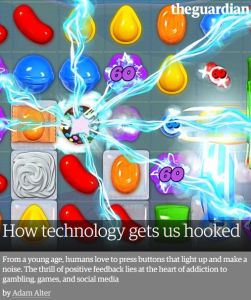
How Technology Gets Us Hooked
From a young age, humans love to press buttons that light up and make a noise. The thrill of positive feedback lies at the heart of addiction to gambling, games, and social media
The Guardian,
2017
1×



Right-click on the code to copy the image.
Note: On an ASP portal, the link behind the code is portal specific!
Recommendation
Why does the little like button below your latest Facebook post make you keep checking your profile? Because you never know how many likes you’ll get. Unpredictable feedback motivates people, says Adam Alter, a professor of psychology and marketing at New York University. He explains that as opposed to substance addictions, behavioral addictions hijack human traits that are in and of themselves desirable, such as the drive to improve and to grow. However, addictive technologies may employ these traits toward destructive ends, such as getting you to spend long hours playing video games or waste money on slot machines. getAbstract recommends Alter’s essay on the psychology behind addictive technologies to educators, social activists and any one tempted to check their Facebook feed before reading on.
Take-Aways
- In his 1971 pigeon experiment, psychologist Michael Zeiler found that randomly dispersed rewards motivated pigeons to peck at a button two times more often than predictable feedback.
- Similarly, humans get easily hooked on unpredictable feedback – such as the number of likes someone receives after posting a picture on Facebook.
- Celebratory sound and light effects at casino slot machines provide rewards that keep gamblers playing even when they are on losing streaks.
- Tetris became a hugely successful video game because it increases in difficulty as the player improves. The thrill of overcoming challenges gets people hooked.
- Tetris displays the player’s mistakes more prominently than it celebrates successes. The urge to correct mistakes keeps players going.
Summary
In 1971, psychologist Michael Zeiler wanted to find out what motivates humans to display desirable behavior. To this end, he conducted an experiment with pigeons. Knowing that even lower-order animals thrive on feedback, he rewarded them with a treat every time they pecked at a button. Zeiler found that when he programmed the button to give out treats randomly, “the pigeons pecked almost twice as often” than when the button dispensed a treat every time they pecked. The “mystery of mixed feedback” thus motivates pigeons the same way “the uncertainty of gambling” gets humans hooked.
“From a young age, humans are driven to learn, and learning involves getting as much feedback as possible from the immediate environment.”
Humans become easily addicted to unpredictable feedback – which is why Facebook users immediately took to the like button the company introduced in 2012. The little button changed Facebook profiles from a stream of pictures and posts to an interactive forum where the number of likes for a posting became a way of measuring social approval. Feedback is also what makes gambling so addictive. Casino slot machines reward gamblers with “bright lights” and “catchy tunes” when they score a win – which motivates gamblers to keep playing even when they’re losing. The thrill of an occasional win keeps them going.
“Humans find the sweet spot sandwiched between ‘too easy’ and ‘too difficult’ irresistible. It’s the land of just-challenging-enough computer games, financial targets, work ambitions, social media objectives and fitness goals.”
People quickly get bored with games in which they always come out on top. Without experiencing setbacks and challenges, the thrill of victory won’t produce the emotional highs human crave. This is also the principle behind one of the most successful video games of all time, Tetris. The longer you play and the better you get at it, the more difficult the game becomes. Furthermore, Tetris makes you see your mistakes longer than your successes. The lines you complete quickly flash and then disappear, while the mistakes you make remain on the screen. The urge to correct mistakes keeps players going. Behavioral addictions are so powerful because they feed on humans’ innate drive to perfect their skills and to grow. Games that offer “a sweet spot” in between not-too-hard and not-too-easy are the most addictive because humans like to chase realistic targets and revel in the thrill of reaching them.
About the Author
Adam Alter is an associate professor of marketing and psychology at New York University’s Stern School of Business and the author of Irresistible: The Rise of Addictive Technology and the Business of Keeping Us Hooked.
This document is intended for the use of LearnHub getAbstract employees.
My Highlights
Select the sections that are relevant to you. Your highlights will appear here.
Did you like this summary?
Read the articleThis summary has been shared with you by getAbstract.
We find, rate and summarize relevant knowledge to help people make better decisions in business and in their private lives.


Already a customer? Log in here.

Comment on this summary