
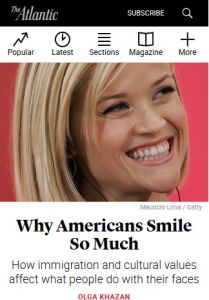
Olga Khazan
Why Do Americans Smile So Much?
The Atlantic, 2017
What's inside?
To smile or not to smile – the answer depends on your location.


Summary availability: Worldwide
Recommendation
If you want to know what people are really thinking, Reddit is usually a pretty good place to start. When someone posed the question, “What’s a dead giveaway that someone is American?” Redditors delivered. The consensus was that people from the land of the free and the home of the brave walk around grinning like lunatics for no good reason. If Americans smile too much, some other cultures tend to lean toward the grim side. Why such a discrepancy in facial expressions? The Atlantic’s Olga Khazan digs into the research. getAbstract recommends this illuminating article to traveling businesspeople and expats.
Take-Aways
- Facial expressions have different connotations in different countries.
- Research suggests that people from immigrant nations tend to smile more, perhaps as a way to overcome language barriers.
- Less diverse countries tend to have inflexible hierarchies, and facial expressions (including smiles) often play a complicated role in maintaining these hierarchies.
- In nations like America where high-energy happiness is desirable, politicians tend to wear “excited” smiles. In nations that value calm (China, for example), tranquil smiles are appropriate.
- American cheerfulness isn’t always successful when exported. Both McDonald’s and Walmart have struggled to adjust when expanding to more sober countries.
Summary
The denizens of some countries smile less than others. Smile too much in Russia, and the locals will think you’re foolish. In another country, a smile could characterize someone trying to communicate his or her superiority. In yet another country, people tend to distrust a person who smiles for no reason. Meanwhile, in Finland, “When a stranger on the street smiles at you, a) you assume he is drunk, b) he is insane [or] c) he’s an American.”
“It turns out that countries with lots of immigration have historically relied more on nonverbal communication. Thus, people there might smile more.”
A 2015 study found that immigration might be the reason behind all the grins. Researchers examined the origin of immigrants to various countries since the year 1500. America has accepted immigrants from 83 countries. In Canada, that number is 63. In diverse countries like these, a smile might be an attempt to communicate benign intentions between two people who lack a common language. Less diverse countries tend to have less flexible social hierarchies, and smiles can have an entirely different meaning. Likewise, in countries with a history of instability, smiling without a specific reason seems absurd.
“In the countries that are more uniform, people were more likely to smile to show they were superior to one another.”
The same research found that attitudes toward conveying emotion varied by nationality. Participants from more diverse countries were more in favor of displaying feelings through facial expressions. Homogeneous societies tended to hold their feelings a bit closer to the vest. This might be related to which emotions each society values. A study from 2016 asked college students how often they wanted to feel certain emotions – excitement, for example, or calm – in a given week. Their answers correlated with the facial expressions of their politicians. An examination of the official portraits of American politicians reveals large, excited smiles. This isn’t as true of Chinese legislators.
“Cultural differences in the value and uses of smiles are also why it can be hard for iconic American companies to expand overseas.”
Cultural differences have implications for business, and differences in emotional expressiveness are no exception. McDonald’s employees in Russia found the rituals of American cheerfulness to be bizarre, and Walmart employees in Germany had to tone it down when male customers construed coached friendliness as flirting. Cheerful employee behavior can be a tough product to export.
About the Author
Olga Khazan is a staff writer for The Atlantic. She has also written for The Washington Post, Los Angeles Times, Forbes and Wired.
This document is restricted to personal use only.
My Highlights
Did you like this summary?
Read the articleThis summary has been shared with you by getAbstract.
We find, rate and summarize relevant knowledge to help people make better decisions in business and in their private lives.
Already a customer? Log in here.
Comment on this summary