
Navigation überspringen
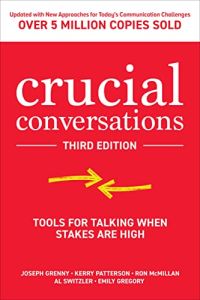
Crucial Conversations
Book

Crucial Conversations

Tools for Talking When Stakes Are High

McGraw-Hill, 2021
First Edition: 2002 Mehr

Buy the book


Editorial Rating

8

getAbstract Rating

  • Applicable
  • Concrete Examples
  • Engaging

Recommendation

If you struggle to manage difficult conversations, don’t despair: Anyone can learn to improve their communication skills and achieve better outcomes, say Joseph Grenny, Kerry Patterson, Ron McMillan, Al Switzler, and Emily Gregory. Their essential guidebook to navigating high-stakes, emotionally-charged interactions balances illustrative anecdotes with practical information. Learn how to handle what the authors call “Crucial Conversations” with grace, and develop the skills you need to cultivate meaningful dialogue and foster stronger relationships.

Summary

Deftly handling “Crucial Conversations” is a critical professional and life skill.

A “Crucial Conversation” isn’t simply a thorny dialogue; it’s a high-stakes discussion rife with diverging opinions and intense emotions that can significantly influence your relationship with your counterpart. Examples of Crucial Conversations include calling out a colleague’s racist behavior, confronting a friend about substance abuse, or giving a team member difficult feedback.

People often avoid difficult interactions, seeing engagement in such conversations as a choice between honesty and maintaining the relationship. However, this is a false binary. The longer you postpone a Crucial Conversation, the more room you create for misunderstanding and resentment. Unless you talk through your issues, the relationship will disintegrate. At the same time, if you handle a confrontation poorly, you could end up harming the relationship anyway. Humans’ fight-or-flight response to conflict can easily sabotage even the most well-meaning efforts at communication.

If you learn to conduct them properly, Crucial Conversations can offer the best of both worlds: allowing you to resolve ...

About the Authors

Joseph Grenny, Ron McMillan, and Al Switzler are social scientists for business performance and organizational change. Kerry Patterson is a professor of econometrics at the University of Reading. Emily Gregory is a writer and business consultant.


Comment on this summary