Skip navigation
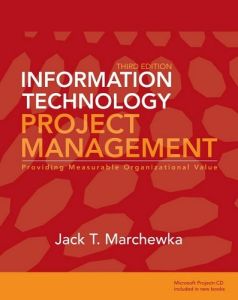
Information Technology Project Management
Book

Information Technology Project Management

Providing Measurable Organizational Value

Wiley, 2009
First Edition: 2002 more...

Buy the book


Editorial Rating

7

getAbstract Rating

  • Applicable
  • Well Structured
  • Overview

Recommendation

In this textbook on managing information technology (IT) projects, Jack T. Marchewka gives clear explanations of sound project-management principles. The book’s organization and tone are designed for a college setting. Of course, you can read the book on your own and get a great deal from it, even without classroom discussion of its case studies and review questions. Note the bullet points that list each chapter’s objectives as items to prioritize as you read. Each chapter’s summary will help you determine if you picked up what the author is trying to share. Marchewka’s language is formal but readable, and he focuses less on entertaining you than on communicating solid, useful information. He thoroughly describes IT projects’ special considerations, emphasizing the importance of human interaction and employee training and skills. getAbstract recommends this book to project managers with IT backgrounds who want to hone their people-management skills and to general project managers who want information on handling IT projects.

Summary

What Makes IT Projects a Bit Different

While projects involving information technology (IT) are much like any other projects, they do have some differences. Since IT provides a support service, proponents of IT upgrades must justify their projects by showing the extra value the organization will gain. IT projects combine highly technical systems and a range of people, some of whom will be technically savvy and many of whom will simply be users of the end product. IT project managers need to be sensitive to people issues and not get sidetracked by the neat technologies they are installing. Ignoring project management formalities is inefficient, too. Introduce a new system only after considering how it will affect every stakeholder. Document and retain details of all the IT systems implemented, how to use them, who is supposed to use them and what business processes depend on them.

How to Begin Thinking About IT Projects

While every project is unique, having a proven template you can tailor to fit your project is better than trying to reinvent the practice of IT project management. Start by developing your business case for the project by working with ...

About the Author

Jack T. Marchewka teaches Management Information Systems at Northern Illinois University. He has also taught at the Rotterdam School of Management in the Netherlands. His articles have been published in several industry journals.


Comment on this summary

More on this topic

Related Skills

AI Transformation
Become More Adaptable
Become More Productive
Communicate Effectively
Corporate Finances
Develop the Organization
Digital Transformation
Drive AI Transformation
Drive Team Performance
Enable Digital Organization
Execute Digital Operations
Foster a Culture of Innovation
Foster Team Culture
Human Resources
Innovation
Lead Operational Planning
Lead Strategically
Leverage AI for Leadership
Manage Product Innovation
Manage Supply Chain Operations
Manage Teams and Departments
Management
Master Collaboration
Master Interpersonal Skills
Personal Growth
Plan Financial Performance
Plan Strategically
Production and Logistics
Soft Skills
Understand Innovation
Understand Organizations
Workplace Skills
Drive Product Development
Lead Yourself
Guide Teams Through AI Transition
Embrace Intelligent Failure
Apply Scrum
Optimize Resource Use
Foster Collaboration
Manage Organizational Knowledge
Increase Your Cultural Awareness
Enhance Team Agility
Manage Project Stakeholders
Manage Project Resources
Manage Change
Drive Project Management
Master Budgeting
Use AI Ethically as a Leader
Drive AI Adoption in Teams
Manage Procurement
Manage Team Communication
Navigate Leadership Challenges
Act Ethically
Manage People and Talent
Collaborate Across Functions
Implement Agility
Manage IT Vendors and Contracts
Embrace Change
Ensure Production Quality
Strengthen Team Collaboration
Executive Leadership
Manage Risk
Understand Organizational Change
Leadership
Build Digital Culture
Communicate Transparently
Manage Project Timelines
Practice Servant Leadership
Leverage Outsourcing and Offshoring
Navigate Uncertainty
Communicate with Stakeholders
Understand Leadership Approaches
Manage Your Leadership Impact
Shape Organizational Culture
Plan and Execute Projects
Lead Ethically
Practice Transformational Leadership
Drive Change Without Authority
Ensure Quality Control
Manage Project Risks
Manage Project Scope and Budgets