
Skip navigation
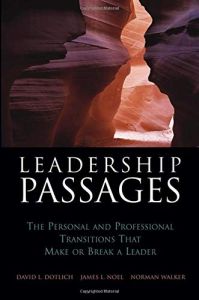
Leadership Passages
Book

Leadership Passages

The Personal and Professional Transitions That Make or Break a Leader

Jossey-Bass, 2004 Mehr

Buy the book


Editorial Rating

9

getAbstract Rating

  • Innovative
  • Applicable

Recommendation

Authors David L. Dotlich, James L. Noel and Norman Walker connect the growing body of work about the emotional intelligence of leaders with the practice of executive coaching and leadership development. Where does emotional intelligence come from, and how can you stimulate its development in the next generation of leaders? The authors’ answer is that growth is indivisible from pain and change. Any great leader fights personal and professional battles, and earns a few scars. The bottom line: what doesn’t kill you makes you stronger. For individual leaders-in-training, the question is how to grow after being hit by life’s curveballs. For firms, the question is how to incorporate executives’ personal lives and career setbacks into their development as leaders. In this regard, the book bridges a gap in executive development literature. getAbstract.com very highly recommends it to those experiencing difficult transitions, and to human resource and development professionals.

Summary

A Passing Phase?

When the CEO of a large corporation was asked about his executive team, he listed their diverse skills and accomplishments. Then he added one other thing, almost as a badge of honor. All of them, he said, had been fired. This was a surprising admission in an era when executives are expected to amass spotless resumes. Yet this CEO saw the experience of falling down and getting back up as a positive factor, rather than a negative one.

Even the most exemplary executive career reflects passages. A passage is an experience that leaves you changed and enables you to develop. Passages have three characteristics: they are predictable, they are intense and they evoke change. Passages alter your perspective and change your view of your work or yourself. They can motivate you to acquire new skills or learn new behaviors.

The following 13 passages are common experiences in the lives of corporate leaders. Effective leaders learn through failure, which provides a second chance to get it right. Most corporate development programs fail to consider the impact that passages have on the next generation of leaders.

Passage One: "Joining a Company"

...

About the Authors

David L. Dotlich is CEO and managing partner of CDR International, a unit of Mercer Delta Consulting. As former executive vice president of an international company, he is a coach to executive leaders worldwide. James L. Noel is a principal of CDR International and the former director of executive education for a major U.S. corporation. Norman Walker has served as the top human resource officer for several large national and international corporations.


Comment on this summary

More on this topic

Related Skills

Be Emotionally Intelligent
Become More Adaptable
Build Confidence
Communicate Effectively
Future of Work
Drive Team Performance
Foster a Culture of Innovation
Foster Team Culture
Human Resources
Innovation
Lead Ethically
Live Well
Management
Master Collaboration
Place Talent Strategically
Workplace Skills
Develop Team Members
Increase Your Cultural Awareness
Overcome Challenges
Set Boundaries
Build Your Presence
Develop Self-Awareness
Emerging Leadership Approaches
Manage Change
Lead Strategically
Mentor Employees
Advance as a Woman Leader
Embrace Challenges
Navigate Office Politics
Coach People
Create Career Pathways
Navigate Uncertainty
Practice Servant Leadership
Live Intentionally
Master Business Etiquette
Become a Mentee
Leverage Your Strengths
Manage Up
Understand Organizational Culture
Understand Organizations
Build Your Resilience
Cultivate a Growth Mindset
Support Team Members’ Careers
Improve Your Mental Health
Master Interpersonal Skills
Navigate Leadership Challenges
Be Authentic
Manage Your Emotions
Adopt a Learning Habit
Understand Cultural Differences
Set Career Goals
Advance Your Career
Find Meaning
Leadership
Manage People and Talent
Become a Self-Driven Learner
Personal Growth
Executive Leadership Case Studies
Lead Yourself
Soft Skills
Work Abroad
Practice Transformational Leadership
Build and Maintain Well-Being
Lead through Change
Understand Yourself
Executive Leadership
Be Coachable
Support Internal Mobility
Career
Dare to be Vulnerable
Develop Grit
Shape Organizational Culture
Develop Leaders
Plan Your Career
Manage Your Leadership Impact
Understand Leadership Approaches
Deal with Difficult People
Develop Self-Mastery
Find Your Purpose
Take Personal Accountability
Promote Failure-tolerance
Develop Parenting Skills
Embrace Intelligent Failure
Navigate Workplace Culture
Succeed in a New Job