Skip navigation
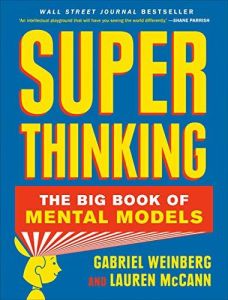
Super Thinking
Book

Super Thinking

The Big Book of Mental Models

Portfolio, 2019 more...

Buy the book


Editorial Rating

8

getAbstract Rating

  • Applicable
  • Well Structured
  • Concrete Examples

Recommendation

People use mental models – that is, concepts – to approach, analyze, or anticipate decisions and problem-solving. “Super models” imbue you with the power of super thinking to strengthen your decision-making skills. Husband-and-wife team Gabriel Weinberg and Lauren McCann list 300+ mental models from (and applicable to) a wide range of fields to guide you through challenging decisions. Their insightful, fast-paced reference manual offers practical examples you’ll read and return to again and again.

Summary

Apply mental models to improve how you make decisions and handle complexity.

Mental models are decision-making frameworks that assist you in making complex decisions and help you differentiate between good and bad ideas. “Super models” provide the power of “super thinking,” which strengthens your decision-making skills. These models function as shortcuts that zip you past “lower-level thinking.”

Investor Charlie Munger, the late vice chairman of Berkshire Hathaway, championed mental models as tools that help you arrange facts into usable structures. Speaking at Stanford Law School in 1996, Munger emphasized that effective multidisciplinary thinking means embracing the best ideas from various disciplines. Mental models help you jump boundaries.

Most mental models aren’t innate, but you can learn and apply them to a variety of categories and situations. After you internalize the models, it’s difficult to consider functioning without them. For example, multiplication is a mental model; it creates greater efficiencies than addition, a simpler model. Once you understand multiplication, you can’t imagine&#...

About the Authors

Gabriel Weinberg is the founder and CEO of DuckDuckGo and the co-author of Traction. Articles by statistician and researcher Lauren McCann, PhD, have appeared in The New England Journal of Medicine


Comment on this summary

More on this topic

Related Skills

AI Transformation
Be Emotionally Intelligent
Become More Adaptable
Build and Maintain Well-Being
Communicate Effectively
Corporate Finances
Develop Innovative Products
Develop the Organization
Drive Investments and M&A
Foster a Culture of Innovation
Human Resources
Lead Ethically
Leverage AI for Business Strategy
Leverage AI for Leadership
Leverage AI for Management
Leverage AI in Your Daily Tasks
Live Well
Manage Change
Management
Marketing
Master Interpersonal Skills
Master Marketing Strategy
Navigate Leadership Challenges
Personal Growth
Plan and Strategize Your Sales
Sales
Soft Skills
Understand Organizations
Workplace Skills
Cultivate Flexibility
Manage Team Boundaries
Lead through Change
Analyze Competition
Decide Under Uncertainty
Deal with Difficult People
Manage Investment Portfolio
Understand Leadership Approaches
Embrace Change
Manage Your Leadership Impact
Understand Cognition
Think Strategically
Manage Sales Teams
Collaborate Creatively
Leverage Ambidexterity
Take Other Perspectives
Generate Ideas
Lead Inclusively
Promote Creativity
Innovate Business Models
Understand Personality Types
Drive Business Development
Improve Team Performance
Understand Team Dynamics
Find Your Purpose
Overcome Challenges
Cultivate a Growth Mindset
Master Collaboration
Master Positioning
Lead Yourself
Leadership
Executive Leadership
Think Scientifically
Entrepreneurship
Strengthen Team Collaboration
Enhance Team Agility
Build Psychological Safety
Facilitate Group Ideation
Innovate Strategically
Make Good Decisions
Think Analytically
Use AI for Decision Support
Cultivate Self-Discipline
Understand Statistics
Maintain Work-Life Balance
Practice Servant Leadership
Master Prioritization
Develop Your Thinking Skills
Plan Strategically
Innovation
Lead Remote or Hybrid Teams
Motivate Your Team
Solve Problems
Make Data-Driven Decisions
Mitigate Cognitive Biases
Become More Productive
Lead Strategically
Embrace Divergent Thinking
Practice Transformational Leadership
Manage People and Talent
Master Logical Reasoning
Understand Yourself
Foster Team Culture
Ask Questions
Think Critically
Be Creative
Cultivate Curiosity
Manage Your Time
Drive Team Performance
Live Intentionally
Challenge Assumptions