Skip navigation
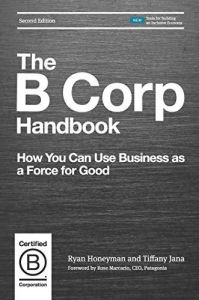
The B Corp Handbook, Second Edition
Book

The B Corp Handbook, Second Edition

How You Can Use Business as a Force for Good

Berrett-Koehler, 2019 more...

Buy the book


Editorial Rating

8

getAbstract Rating

  • Applicable
  • Concrete Examples
  • For Beginners

Recommendation

Ryan Honeyman and Tiffany Jana detail the process of becoming a US Certified B Corp, the benefits and obligations of that status – based on corporate social responsibility – and the values and goals of the B Corp movement. They identify policies and practices in five areas – worker, community, environment, customer impact and company governance – that confer B Corp “certification” points. This handbook provides practical guidance, commentary from B Corp leaders, and specific ideas on how to increase your company’s “diversity, equity and inclusion.”

Summary

Any for-profit US business can achieve B Corp certification, which denotes significant efforts in corporate social responsibility.

Although the “B” in B Corp stands for “benefit,” under US law, B Corps and benefit corporations are not identical. Any for-profit business entity can earn B Corp status, regardless of its legal structure or location. B Corps go through a rigorous process of evaluation to determine whether they are exercising corporate social responsibility and acting as a force for good. Becoming a benefit corporation enables a company to ensure its governance will continue to serve a broader range of stakeholders beyond its shareholders alone.

B Corps must show their dedication to serving humanity by improving the environmental and social well-being of all stakeholders. B Corp businesses can be sole proprietorships, LLCs or partnerships; nonprofits are not eligible. Corporations that want to achieve B Corp certification in jurisdictions that offer benefit corporation status must reincorporate as benefit corporations to retain their B Corp status beyond initial certification. A company legally structured...

About the Authors

Ryan Honeyman is a partner/worker-owner at LIFT Economy. He assists companies in becoming B-Corps and making the most of their certification. Dr. Tiffany Jana is founder and CEO of TMI Portfolio, which advances social responsibility, diversity, inclusion and equity in business.


Comment on this summary

More on this topic

Related Skills

Be Emotionally Intelligent
Develop a Business Plan
Public Sector
Future of Work
Entrepreneurship
Executive Leadership
Govern Compliance and Risk
Increase Your Cultural Awareness
Lead Strategically
Leadership
Live Well
Manage Corporate Communications
Manage Performance
Manage Supply Chain Operations
Management
Market Insights by Industry
Marketing
Personal Growth
Plan Strategically
Production and Logistics
Promote Diversity, Equity, and Inclusion
Sales
Soft Skills
Understand Economics
Conduct Employee Surveys
Discover Sustainability Case Studies
Support Employees’ Mental Health
Communicate Corporate Strategy
Drive Sustainable Innovation
Public Sector Regulation
Discover Societal Shifts
Oversee Corporate Governance
Understand Business Case for ESG
Manage Post-Sale Relationships
Understand Human Behavior
Build an Inclusive Culture
Manage People and Talent
Define Purpose, Vision, and Mission
Enhance Customer Experience
Drive Employee Engagement
Promote Disability Inclusion
Understand Environmental Degradation
Human Resources
Implement ESG Reporting and Compliance
Manage Complaints
Promote Ethnic Inclusion
Develop Climate Adaptation Strategies
Retain Employees
Manage Customer Accounts
Offer Flexible Work Arrangements
Inequality
Promote Customer Centricity
Build and Maintain Well-Being
Understand Climate Risks
Manage Employee Relations
Deliver Exceptional Service
Understand Environmental Economics
Implement Green Technologies
Implement ESG Strategies
Understand Climate Change
Support Employees’ Well-being
Communicate Corporate Purpose
Promote Socio-Economic Inclusivity
Enhance Employee Experience
Manage Climate Risks
Make Supply Chain Sustainable
Sustainability
Live Sustainably
Mitigate Carbon Footprint