

Article
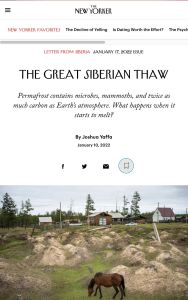
The Great Siberian Thaw
Permafrost contains microbes, mammoths, and twice as much carbon as Earth’s atmosphere. What happens when it starts to melt?
The New Yorker,
2022



Klicken Sie mit der rechten Maustaste auf den Code, um das Bild zu kopieren.
Hinweis: Bei ASP-Portalen ist der Link hinter dem Code portalspezifisch!
Recommendation
This somber investigation into permafrost thaw in Siberia in Russia’s far northeast reveals that there is much that climate scientists don’t know, and don’t have a lot of time to find out. For centuries, making permafrost regions habitable had been a long-cherished goal for Russia. Now, having “conquered” it, they face new challenges. With rising temperatures in the far north, permafrost is melting at an alarming rate, damaging infrastructure and releasing carbon and methane. Can science reverse the trend and “refreeze” permafrost, or will the melt exacerbate the climate crisis?
Summary
About the Author
Joshua Yaffa is based in New York and Moscow and is a contributing writer at The New Yorker. He has written for the Economist, The New York Times, National Geographic, Bloomberg Businessweek, New Republic and Foreign Affairs. He is the author of Between Two Fires: Truth, Ambition and Compromise in Putin’s Russia.

Comment on this summary