


Navigation überspringen
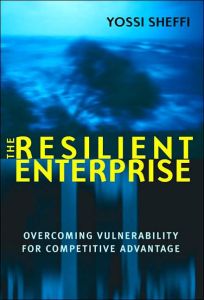
The Resilient Enterprise
Book

The Resilient Enterprise

Overcoming Vulnerability for Competitive Advantage

MIT Press, 2005 Mehr

Buy the book


Editorial Rating

8

getAbstract Rating

  • Innovative
  • Applicable

Recommendation

A fire burns down the manufacturing plant of your key supplier, who makes parts you absolutely must have. A contractor miles away accidentally cuts a communication cable, taking your entire information system offline. A labor strike shuts down ports, and your products sit offshore for weeks. All of these scenarios have damaged companies in the past. However, today, in the post-9/11 era, terrorism has elevated your risk to entirely new levels. Is your organization ready to cope? Yossi Sheffi, an international expert in supply chain management, shows you how to determine your company’s level of vulnerability, and what to do to become resilient in the face of setbacks. getAbstract recommends this book to executives who want to prepare for disaster.

Summary

Expect the Unexpected

When a line of thunderstorms touched off a fire at a Philips computer-chip plant in Albuquerque, New Mexico, on March 17, 2000, it seemed like no big deal. When firefighters arrived, they learned that Philips personnel had already extinguished the blaze, and no one had been injured. That minor fire, however, touched off a supply chain disruption for major corporations around the globe. The reason: Fabrication rooms must be among the cleanest places on earth, and soot and water contamination effectively shut down Philips’s chip operation.

Nokia realized right away that the disrupted delivery would jeopardize the assembly of about four million cell phones. Thirty Nokia officials flew to Europe, Asia and the United States in search of a solution. Ultimately, they found factories in the Netherlands and Shanghai that could provide the chips they needed.

Ericsson, which also relied on the plant’s chips, reacted more slowly. Company executives took longer to understand the extent of the problem. By the time they realized how widespread the chip shortage was, Nokia had seized all the spare capacity. As a result, Ericsson experienced losses of between...

About the Author

Yossi Sheffi is a professor of engineering systems at the Massachusetts Institute of Technology and director of the MIT Center for Transportation and Logistics. An internationally recognized expert on supply chain management, he has worked with leading companies around the globe.


Comment on this summary

More on this topic

Related Skills

AI Transformation
Build and Maintain Well-Being
Build Your Startup
Develop the Organization
Digital Transformation
Aerospace and Defense Industry
Transport and Logistics
Drive Project Management
Execute Digital Operations
Human Resources
Innovate Strategically
Innovation
Lead Strategically
Live Well
Manage People and Talent
Manage Supply Chain Operations
Market Insights by Industry
Navigate Leadership Challenges
Personal Growth
Plan Strategically
Sustainability
Understand AI
Understand Economics
Understand Innovation
Understand Organizations
Use AI for Production & Supply Chain
Use Scenario Planning
Mitigate Carbon Footprint
Manage Supply Chain Risks
Executive Leadership
Production and Logistics
Use AI for Disruption Monitoring
Cultivate a Growth Mindset
Develop Grit
Understand Organizational Change
Manage Project Risks
Management
Shape Organizational Culture
Build Security Culture
Navigate Uncertainty
Enhance Cybersecurity
Succeed as an Entrepreneur
Transport and Logistics Challenges
Leadership
Manage Change
Lead Through Crises
Business Cycles
Cultivate Positivity
Innovate Business Models
Discover Supply Chain Risks
Manage Cyber Risk
Build Your Resilience
Ensure Business Continuity
Entrepreneurship
Respond to Security Incidents
Understand AI Risks
Cultivate Flexibility
Leverage Ambidexterity
Aerospace and Defense Challenges
Embrace Change
Become More Adaptable
Implement Agility
Understand Climate Risks
Develop Climate Adaptation Strategies
Manage Crises
Manage Risk
Overcome Challenges
Lead through Change
Manage Climate Risks