Skip navigation
Wicked Strategies
Book

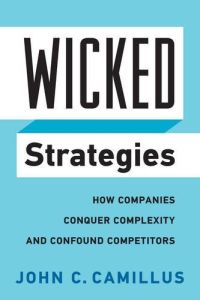
Wicked Strategies

How Companies Conquer Complexity and Confound Competitors

University of Toronto Press, 2016 more...

Buy the book


Editorial Rating

7

getAbstract Rating

  • Innovative
  • Applicable

Recommendation

In business, problems come with the territory. These include the easy ones, the hard ones and the “wicked” ones – convoluted, intransigent challenges that don’t yield to conventional business analysis or tactics. Strategic management professor John C. Camillus lays out a comprehensive “wicked strategies” plan. getAbstract found much to like in this thorough if complex manual. His combinations of concepts aren’t always easy to track, but his fresh analysis and scenario strategies are wicked good.

Summary

“Wicked Problems” Have Wicked Characteristics

Wicked problems are paradoxical and defy understanding. They’re impervious to standard analytical tools. They seem incomprehensible and unsolvable. What makes them seem intractable is that when you apply traditional solutions – thinking they’ll work – wicked problems morph into something new that is more complex and confusing.

While wicked problems are daunting, they present previously unavailable opportunities your organization can exploit to achieve new levels of success and profitability. A wicked problem has five essential characteristics:

  1. The problem largely has no precedent.
  2. The affected stakeholders are diverse and hold conflicting interests.
  3. The problem exists for many reasons, all inextricably linked.
  4. The business’s leaders can’t be certain a solution exists.
  5. The essence of the problem changes depending on the proposed solutions.

“Megaforces”

Wicked corporate problems arise due to three interacting megaforces, and the intersection of these three powerful drives can rip a firm apart or refresh it ...

About the Author

Since 1991, John C. Camillus has held the Donald R. Beall Chair in Strategic Management at the University of Pittsburgh’s Katz Graduate School of Business, where he served as Associate Dean – the COO and chief academic officer – from 1982 to 1990. Camillus also taught previously at the MBA program at the Indian Institute of Management, Ahmedabad.



Comment on this summary

More on this topic

Related Skills

Advance Your Career
AI Transformation
Become More Adaptable
Become More Productive
Build Your Startup
Career
Communicate Effectively
Develop the Organization
Develop Your Thinking Skills
Digital Transformation
Execute Digital Operations
Human Resources
Lead Operational Planning
Leverage AI for Leadership
Leverage AI for Management
Leverage AI in Your Daily Tasks
Make Good Decisions
Manage Risk
Manage Teams and Departments
Market Insights by Industry
Navigate Leadership Challenges
Personal Growth
Sales
Soft Skills
Strengthen Team Collaboration
Workplace Skills
Decide Under Uncertainty
Plan Strategically
Streamline Your Workflow
Apply Open Innovation
Communicate Strategically
Innovation
Future of Work
Navigate Uncertainty
Leverage AI for Business Strategy
Management
Champion New Ideas
Think Strategically
Translate Strategy into Action
Manufacturing Industry
Production and Logistics
Drive Organizational Performance
Strategize Digital Transformation
Take Group Decisions
Understand Innovation
Challenge Assumptions
Executive Leadership
Foster a Culture of Innovation
Develop Innovative Products
Be Creative
Leadership
Plan and Strategize Your Sales
Manage Change
Master Systems Thinking
Organize Innovation
Ensure Business Continuity
Discover AI Vendors for Business Strategy
Engage in Intrapreneurship
Use AI for Decision Support
Solve Problems
Lead through Change
Entrepreneurship
Lead Strategically
Innovate Strategically
Implement Agility
Succeed as an Entrepreneur
Innovate Business Models
Leverage Ambidexterity
Overcome Challenges
Use Scenario Planning