Saltar la navegación
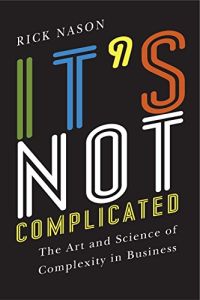
It’s Not Complicated
Book

It’s Not Complicated

The Art and Science of Complexity in Business

University of Toronto Press, 2017 más...

Buy the book


Editorial Rating

7

getAbstract Rating

  • Applicable
  • Concrete Examples

Recommendation

Drawing on systems thinking, professor Rick Nason encourages you to differentiate among “simple, complicated and complex” problems. He explains the “false axioms of business” and seven ongoing “paradigm shifts“ to help you understand how each type of problem requires a unique approach. Nason draws from economic theory, scientific management and behavioral research to offer a broad perspective on problem solving. At times you might feel a bit lost in this rather complicated – or complex? – approach to strategic thinking, but Nason cites business examples, both recent and historic, to help you connect the dots. getAbstract recommends his take on conquering the “complexity-thinking paradigm” to businesspeople and managers who may sometimes feel stuck in old ways of attacking hard problems.  

Summary

“Introduction to Systems and Complexity”

You can apply systems thinking to many fields, such as the natural sciences and engineering, to describe how things work and how to get tasks done. However, systems thinking is less known in the business world. Across fields, systems thinking differentiates among three kinds of tasks:

  • A simple task – Making coffee is a simple task because it is straightforward, it doesn’t require much skill training and it’s easy to determine if you’ve achieved the right result.
  • A complicated task – Preparing accounting statements is complicated because you need to be an expert who understands financial rules. Following these rules exactly produces a well-defined outcome. You can reproduce this outcome by giving the same task to another accountant who should come up with the same results.
  • A complex task – Giving a sales presentation differs from making coffee or preparing accounting statements because it doesn’t follow a prescribed, linear path to success. Each sales meeting is unique; results depend on positive interaction between you and the client. You...

About the Author

Rick Nason is an associate professor of finance in the Rowe School of Business at Dalhousie University in Halifax, Nova Scotia.



Comment on this summary

  • Avatar
  • Avatar
    J. M. 2 years ago
    Good
  • Avatar
    M. F. 8 years ago
    The main point derived from this abstract of Its not complicated’ is that Solving complex problems requires strong leaders willing to work through problems as they arise.Unlike simple and even complicated problem ,solutions to complex problems cannot be solved using reason or logic alone.The reason being that there is no one obvious or best solution to complex problems like climate change for instance.One must think systemically like a chess player and anticipate problems as they arise and take one decision (move) toward the final objective (checkmate).It requires intelligence but even more confidence that your intuition can take you to the finish line.This view of business seems to follow that of other disciplines like behavioral economics and behavioral finance.This novel idea of complexity may led to a new field of Behavioral Business .It will require emotional intelligence when dealing with people and making decisions.It also requires thinking about the paradigm shifts in business which result and having to deal with more complex situations than ever before

More on this topic

Related Skills

Desarrolle la organización
El futuro del trabajo
Impulse la gestión de proyectos
Mejore la experiencia de los empleados
Foster Team Culture
Recursos humanos
Aumente su conciencia cultural
Innove estratégicamente
Innovación
Lidere la planificación operativa
Tome buenas decisiones
Gestione el cambio
Gestione el desempeño
Administración
Domine la colaboración
Crecimiento personal
Comprenda la innovación
Habilidades para el lugar de trabajo
Comprenda la creatividad
Desarrolle sus habilidades de pensamiento
Planifique estratégicamente
Comprenda las organizaciones
Controle el estrés
Navegue por la cultura del lugar de trabajo
Impacto de la tecnología en el trabajo
Lidere a través del cambio
Work Remotely
Reconozca señales sociales
Comprenda el comportamiento humano
Mejore su salud mental
Adopte otras perspectivas
Comprenda los tipos de personalidad
Trate con personas difíciles
Emprendimiento
Liderazgo
Govern Compliance and Risk
Desarrolle la determinación
Innove en los modelos de negocio
Sea creativo
Abrace el cambio
Habilidades blandas
Comprenda las emociones
Navigate Leadership Challenges
Navegue por la incertidumbre
Comprenda el comportamiento social
Construya y mantenga el bienestar
Decida bajo incertidumbre
Manage People and Talent
Gestione los riesgos del proyecto
Acepte los desafíos
Comprenda la cognición
Desarrolle su resiliencia
Resuelva problemas
Liderazgo ejecutivo
Gestione sus emociones
Gestione el riesgo
Descubra cambios sociales
Cultive la flexibilidad
Comprenda el cambio organizacional
Sea emocionalmente inteligente
Desarrolle la autoconciencia
Sea más adaptable
Cultive una mentalidad de crecimiento
Enfoques de liderazgo emergente
Lidere estratégicamente
Lidérese a sí mismo
Compréndase a sí mismo
Navegue por la política de la oficina
Supere desafíos
Piense estratégicamente
Aproveche la ambidestreza
Domine habilidades interpersonales
Domine el pensamiento sistémico