Únete a getAbstract para acceder al resumen.

Work for What's Next

Únete a getAbstract para acceder al resumen.
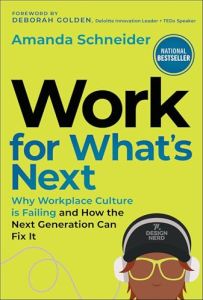
Work for What's Next

Why Workplace Culture is Failing and How the Next Generation Can Fix It

Wiley,

15 mins. de lectura
9 ideas fundamentales
Audio y Texto

¿De qué se trata?

Is gen Z breaking the workplace or merely exposing preexisting cracks in its foundation?

1×

Editorial Rating

8

getAbstract Rating

  • Well Structured
  • Overview
  • For Beginners

Recommendation

As gen Z enters the workforce in greater numbers, organizations that cling to yesterday’s management practices will find themselves struggling to attract, develop, and retain top talent. In this well-structured report, workplace strategist Amanda Schneider shares her research into how the members of gen Z are pushing organizations to reshape their cultures in ways that benefit all of their employees. Her real-world examples and actionable strategies show readers how to build stronger hybrid teams, redesign outdated management systems, prioritize transparency, and support learning and good communication across generations.

Summary

Digital and face-to-face communication can complement each other instead of competing.

Younger workers want flexibility about when and how they work. Gallup data shows that neither gen Z nor Millennial workers want to spend every weekday in the office — particularly given that modern on-site workers often spend more time in video meetings than interacting face-to-face with their colleagues and clients. Company leaders may blame flexible work arrangements for their organizations’ workflow problems, but a remote team that struggles to collaborate will not magically align thanks to a return-to-office mandate. Even a fully in-office team needs to be able to handle distributed communication tools, numerous time zones, and hybrid client relationships. Modern organizations must create a communication strategy that works whenever, wherever, and however work gets done.

Start by creating an information-flow hierarchy that establishes which channel to use for what type of communication. For example, use email for the least urgent messages and phone calls for the most urgent. Be aware that online tools work best for sharing information and creating initial connections. Save time...

About the Author

Amanda Schneider is the founder and president of ThinkLab, a research and content studio focused on the built environment and the interior design industry.  She is a TED speaker and host of the podcast “Design Nerds Anonymous.”  


Comment on this summary