

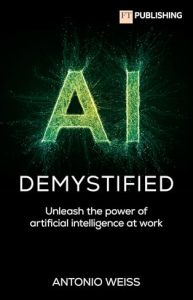
Book
AI Demystified
Unleash the Power of Artificial Intelligence at Work
FT Publishing,
2025
plus...
FT Publishing © 2025
This authorized summary of AI DEMYSTIFIED is published by arrangement with Pearson Education Limited.
ISBN: 9781292742670
Pages: 296
This authorized summary of AI DEMYSTIFIED is published by arrangement with Pearson Education Limited.
ISBN: 9781292742670
Pages: 296


We currently cannot offer you an audio version of this summary.



Cliquez sur le code avec le bouton droit de la souris pour copier l'image.
Remarque : Sur un portail ASP, le lien mentionné à côté du code est spécifique au portail !
Recommendation
Artificial intelligence has existed since the 1950s, but generative AI tools like ChatGPT have the potential to completely transform people’s personal and working lives, senior AI adviser Antonio Weiss writes. Still, even major technological innovations don’t change the world overnight, and the same will likely be true for generative AI: This is just the dawn of the generative AI era. The important thing is to get ahead of the curve. Weiss offers a non-technical guide for how you and your organization can become active participants in the still-young generative AI revolution.
Summary
About the Author
Antonio Weiss is a senior partner at The PSC, the UK’s longest-standing public service specialist consultancy. He has advised the Office for Artificial Intelligence and other organizations seeking AI adoption and digital transformation. He is also an affiliated researcher at the University of Cambridge’s Digital State program.
Learners who read this summary also read
Related Skills

Compétences professionnelles

Tirez parti de l'IA dans vos tâches quotidiennes

Conduire la transformation par l'IA

Création d’entreprise

Leadership

Tirer parti de l'IA pour le leadership

Exploiter l'IA pour le marketing

Exploiter l'IA pour le développement de produits

Marketing

Comprendre l'IA

Guider les équipes à travers la transition vers l'IA

Utiliser l'IA de façon éthique

Plan de transformation de la main-d'œuvre AI

Comprendre l'impact éthique de l'IA

Utilisez l'IA pour le prototypage

Comprendre l'impact sociétal de l'IA

Transformation par l'IA

Comprendre l'impact de l'IA sur le travail

Utilisez l'IA pour l'écriture et la communication

Rédigez des invites efficaces pour l'IA

Utilisez l'IA pour générer du contenu marketing

Comprendre les risques de l'IA

Utilisez l'IA pour la création d'images et de vidéos

Utilisez l'IA pour générer des idées

Comprendre l'IA générative

Comment on this summary