
Ignorer la navigation
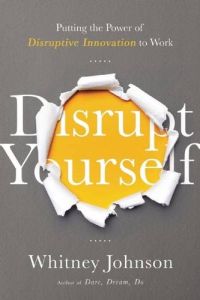
Disrupt Yourself
Book

Disrupt Yourself

Putting the Power of Disruptive Innovation to Work

Bibliomotion, 2015 plus...

Buy the book


Editorial Rating

7

getAbstract Rating

  • Applicable

Recommendation

Analyst Whitney Johnson applies Clayton Christensen’s concept of “disruptive innovation” to individual careers. She uses this idea to offer metaphorical lenses that enable you to see your career with new eyes. Johnson's advice on how to innovate will help you take responsibility for redefining your professional path, however, deliberately disrupting yourself could reshape your career, so your path may look quite different if you undertake her approach. Her guidebook will help readers who are seeking new perspectives on their careers and meaning in their work.

Summary

Making Disruption Personal

Clayton Christensen, author of The Innovator’s Dilemma, popularized the idea of “disruptive innovation.” In this paradigm, companies enter a market by selling a product much cheaper than the firms that currently dominate that market and thus turn it topsy-turvy.

“Disruptors” have little power at first. Larger firms don’t regard them as threats and dismiss them, as American automakers once dismissed Toyota. Those on top don’t defend themselves against or invest in such would-be competitors. Disruptors then embark on a period of intense growth, like America Movil, which went from 1% of the Mexican wireless market to 25% in just five years. As disruptors redefine the playing field, their growth follows a specific pattern – the “S-curve.” At the start, S-curve growth is slow – nearly invisible. The line of the S-curve is almost horizontal. Then the disruption hits a “tipping point”: Growth explodes and the line shifts to sharply vertical. At “saturation,” when the disruptive competitor has captured 90% of the market, its growth drops again.

You can use the S-curve as a model of “personal disruption,” as well as a framework for ...

About the Author

Institutional Investor-ranked analyst Whitney Johnson co-founded Rose Park Advisors and wrote Dare, Dream, Do: Remarkable Things Happen When You Dare to Dream.



Comment on this summary

  • Avatar
  • Avatar
    K. C. 5 years ago
    Considero que es muy importante tomar riesgos , ver el negocio de fuera y enfocarse en la parte emocional de los clientes , entender sus necesidades de cambio, asimismo concuerdo que al ampliar nuestra red , ampliaremos nuestros conocimientos y surgirán nuevas ideas. No debemos temer el fracaso, ya que es un nuevo aprendizaje.
  • Avatar
    L. S. 8 years ago
    Another reminder that growth is possible from failure if viewed through the right lens. I operate from a sense of discovery but need to not get overly distracted from the task at hand.
  • Avatar
    P. C. 9 years ago
    Done

More on this topic

Related Skills

Faire progresser sa carrière
Apprendre à s'adapter
Construire et entretenir le bien-être
Prendre confiance en soi
Rédiger un business plan
Développer son organisation
Direction exécutive
Promouvoir une culture de l'innovation
Générer et qualifier des prospects
Ressources Humaines
Leadership
Bien vivre
Manage People and Talent
Management
Savoir collaborer
Développer ses compétences interpersonnelles
Développement personnel
Vente
Chercher un emploi
Compétences relationnelles
Comprendre les organisations
Compétences professionnelles
Réussir en tant qu'entrepreneur
Développer son image de marque
Gérer l'innovation produit
Surmonter les difficultés
Fixer des limites
Gérer l'incertitude
Découvrir des carrières spécialisées
Planifier sa carrière
Cultiver la flexibilité
Cultiver la curiosité
Cultiver l'autodiscipline
Façonner son emploi
S’adapter à la politique de l’entreprise
Vivre intentionnellement
Construire sa résilience
Se comprendre soi-même
Création d’entreprise
Trouver un but
Innover dans les business models
Penser autrement
Encourager l'expérimentation
Oser se montrer vulnérable
Utiliser le Lean Startup
Évaluer ses compétences
Études de cas sur les start-ups
S’auto-diriger
Développer sa créativité
Trouver du sens
Miser sur l'ambidextrie organisationnelle
Carrière
Innover stratégiquement
Remettre en question les hypothèses
Créer sa startup
Faire preuve d'humilité
Concevoir des produits innovants
Tirer parti de ses points forts
Innovation
Identifier ses points forts
Développer un état d'esprit de croissance
Développer la tolérance à l'échec
Apprendre à échouer intelligemment