
Ignorer la navigation
From Smart to Wise
Book

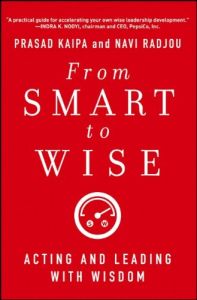
From Smart to Wise

Acting and Leading with Wisdom

Jossey-Bass, 2013 plus...

Buy the book


Editorial Rating

6

getAbstract Rating

  • Well Structured
  • Concrete Examples
  • For Beginners

Recommendation

Leadership and innovation consultants Prasad Kaipa and Navi Radjou present a method that can add depth and dimension to your leadership capabilities in six areas. They explain the differences between “functional-smart” leaders who operate in the “blue zone” and “business-smart” leaders who operate in the “red zone.” Noting that each type has its strengths and limitations, Kaipa and Radjou explain why neither compares to the wise leader who embodies the best of both, and then some. Their manual includes a self-assessment test, a guided program for embarking on your journey toward wise leadership and examples of leaders who personify wisdom. While noting that many of their concepts are tried-and-true, getAbstract humbly suggests that this concise, highly motivational book might help you find the wisdom you seek.

Summary

It’s Good to Be Wise

Some successful leaders are better at seeing the big picture, while others shine at implementing strategies and still others excel at innovation. Each approach has merit. But merely being smart no longer suffices for the challenges of “complex and uncertain times,” and for achieving the personal and professional satisfaction leaders can and want to derive from their leadership efforts. Moving beyond smartness requires persistent dedication to practicing “wise leadership skills.”

Smart leaders are either:

  1. “Functional smart” – These leaders exhibit expertise in a particular area – such as R&D – and deliberate before acting. Conservative about risk, they limit their activities to “what they know best.”
  2. “Business smart” – These leaders like risk, see the bigger picture, have a competitive streak and take a broader perspective.

Both types of leaders stay within their comfort zones. However, wearing blinders – or viewing the world through a “perceptual filter” – can cost them and their companies. Metaphorically, business-smart leaders wear “red filters” and operate in the “red zone...

About the Authors

CEO adviser Prasad Kaipa is the founding executive director of the Center for Leadership, Innovation and Change at the Indian School of Business. Navi Radjou is a World Economic Forum faculty member and co-author of Jugaad Innovation.


Comment on this summary

More on this topic

Related Skills

Faire progresser sa carrière
AI Transformation
Construire et entretenir le bien-être
Carrière
Développer son organisation
Développer sa capacité de réflexion
Drive Team Performance
Foster Team Culture
Ressources Humaines
Innover stratégiquement
Innovation
Bien vivre
Gérer le changement
Manage People and Talent
Management
Savoir collaborer
Développement personnel
Strengthen Team Collaboration
Comprendre les organisations
Compétences professionnelles
Gérer l'incertitude
Pratiquer le Servant Leadership
Diriger en cas de crise
Leverage AI for Leadership
Navigate Leadership Challenges
Prendre des décisions collectives
Développer ses compétences interpersonnelles
Trouver du sens
Diriger de façon éthique
Développer son intelligence émotionnelle
Gérer l'impact de son leadership
Miser sur l'ambidextrie organisationnelle
Apprendre à s'adapter
Réfléchir de manière analytique
Comprendre les approches de leadership
Gérer ses émotions
Construire sa résilience
Faire preuve d'humilité
Oser se montrer vulnérable
Améliorer sa maîtrise de soi
S’auto-diriger
Faire preuve d'esprit critique
Vivre intentionnellement
Évoluer en tant que femme dirigeante
Surmonter les difficultés
Prendre conscience de soi
Développer un état d'esprit de croissance
Changer de perspective
Conduire le changement
Practice Transformational Leadership
Compétences relationnelles
Se forger un moral d'acier
S’adapter à la politique de l’entreprise
Se comprendre soi-même
Faire preuve d’empathie et de compassion
Direction exécutive
Atténuer les préjugés cognitifs
Comprendre la cognition
Maîtriser le raisonnement logique
Diriger stratégiquement
Leadership
Décider dans l'incertitude
Faire preuve d’authenticité
Prendre des décisions fondées sur des données
Prendre de bonnes décisions