Ignorer la navigation
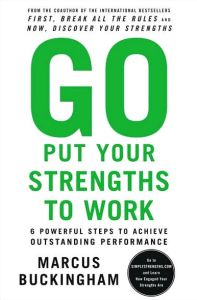
Go Put Your Strengths to Work
Book

Go Put Your Strengths to Work

6 Powerful Steps to Achieve Outstanding Performance

Free Press, 2007 plus...

Buy the book


Editorial Rating

7

getAbstract Rating

  • Innovative
  • Applicable
  • Eye Opening

Recommendation

Marcus Buckingham is passionate about helping you identify your unique strengths and unleash their power. As you read and work your way through the program in this book, you will become convinced that growing through your strengths is the ticket to your future happiness, effectiveness and success. He refutes the approach of improvement by fixing mistakes as a dead end that cannot help you discover how you can be exceptional. The book constantly refers you to its associated Web site for materials that will help you work through the exercises. Buckingham wants you to act rather than just read a theoretical tract. Nothing presented in this book will help you without action and implementation. However, if you take up the challenge, you will become empowered as you take charge of your work through your strengths. getAbstract recommends this book because it contains just a few simple ideas that could change your life.

Summary

Strengths and Mistakes

People make mistakes. The real question is whether you would do better by learning from those mistakes or by focusing on building your strengths instead. Do athletes perform better by filling their minds with images of winning or images of losing? Research says it is the former. Are your workdays filled with tasks that let your strengths flow? Does your work engage your very strongest abilities? Or do you spend your days managing your mistakes?

Recent research has explored two approaches toward business success, “Appreciative Inquiry” and “Positive Organizational Change.” Both have the same fundamental principle: Managing mistakes can help you limit the range of negative outcomes you might incur, but will not contribute to great success. However, if you study what works in your organization and build on it, you can expand your “positive deviance” – that is, the good side of being out of sync with the ordinary. You may consider deviance a negative factor, but it isn’t. It simply indicates that which is out of the norm.

You know that great feeling of accomplishment you get when you have used your best efforts to do a great piece of work? ...

About the Author

Marcus Buckingham is the author and co-author of several best-selling books including First, Break All the Rules; Now, Discover Your Strengths and The One Thing You Need to Know.



Comment on this summary

  • Avatar
  • Avatar
    A. T. 6 years ago
    Interesting
  • Avatar
    V. P. 1 decade ago
    It was a good summary on how best to think about priority of work, who owns the work, and whether or not the work distributed to the team should be re-distributed based on individual team members strengths
  • Avatar
    N. S. 1 decade ago
    Nice Book!!

More on this topic

Related Skills

Faire progresser sa carrière
Développer son intelligence émotionnelle
Apprendre par soi-même
Apprendre à s'adapter
Carrière
Promouvoir une culture de l'innovation
Générer et qualifier des prospects
Ressources Humaines
Innovation
Diriger de façon éthique
Leadership
Bien vivre
Gérer le changement
Management
Savoir collaborer
Développer ses compétences interpersonnelles
Navigate Leadership Challenges
Planifier et élaborer des stratégies de vente
Promouvoir la diversité, l'équité et l'inclusion
Vente
Chercher un emploi
Façonner la culture d'entreprise
Compétences professionnelles
Construire et entretenir le bien-être
Se motiver
Pratiquer la pleine conscience
Prendre confiance en soi
Développer son image de marque
Faciliter les discussions
Manage People and Talent
Créer un sentiment d'appartenance
Develop Team Members
Concilier vie professionnelle et vie privée
Soutenir les carrières de ses collaborateurs
Éviter la procrastination
Diriger de façon inclusive
Développer sa capacité de réflexion
Compétences relationnelles
Promouvoir la collaboration
Améliorer sa santé mentale
Trouver un but
Soutenir ses collaborateurs
Relever les défis
Gérer l'impact de son leadership
Prendre ses responsabilités
Gérer les équipes de vente
Gérer ses relations avec ses supérieurs
Strengthen Team Collaboration
Exercer une influence
Gérer les limites de l'équipe
Pratiquer le Servant Leadership
Oser se montrer vulnérable
Planifier sa carrière
Instaurer des habitudes utiles
Motiver son équipe
Développement personnel
Practice Transformational Leadership
Conduire le changement
Se forger un moral d'acier
Drive Team Performance
Prendre l'habitude d'apprendre
Devenir plus productif
Améliorer sa maîtrise de soi
Identifier ses besoins de développement
Cultiver l'autodiscipline
Renforcer la sécurité psychologique
Trouver du sens
Améliorer l'agilité de l'équipe
Surmonter les difficultés
Positionner les talents stratégiquement
Développer la tolérance à l'échec
Prendre conscience de soi
Se comprendre soi-même
Construire sa résilience
Cultiver la positivité
Renforcer la cohésion de l'équipe
Apprendre à échouer intelligemment
Impulser le changement en douceur
Foster Team Culture
Évaluer ses compétences
S’auto-diriger
Façonner son emploi
Développer un état d'esprit de croissance
Identifier ses points forts
Tirer parti de ses points forts