

Skip navigation
High-Impact Tools for Teams
Book

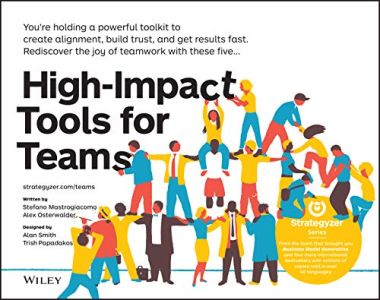
High-Impact Tools for Teams

A powerful toolkit to create alignment, build trust and get results fast. Rediscover the joy of teamwork... (The Strategyzer Series)

Wiley, 2021 more...

Buy the book


Editorial Rating

8

getAbstract Rating

  • Applicable
  • Eye Opening
  • Eloquent

Recommendation

When work teams can’t meet reasonable performance expectations, the problem often turns out to be that the members can't work together in honest, trusting collaboration. As authors Stefano Mastrogiacomo and Alex Osterwalder and designers Alan Smith and Trish Papadakos explain, teams are productive when their members feel psychologically safe and work cooperatively toward a common goal. To facilitate productivity, make sure your work-related activities align, so everyone knows who does what. This practical guide full of often amusing sketches and charts will help anyone who runs a firm, leads a project or works in a team.

Summary

Teams can’t perform well when their objectives are misaligned or their working atmosphere is emotionally unsafe.

Working in teams can be productive and happy or stressful and fatiguing. When work isn’t going well, team members spend half their time in meetings talking at cross-purposes. They have trouble juggling budgets and priorities. The stress and alienation make people unproductive and unhappy.

Teams perform poorly when their work tasks aren’t aligned, and they lack clearly articulated, shared goals. Symptoms of team misalignment include ambiguous division of assignments, shifting priorities and team members who work in unnecessary isolation.

Teams become unproductive when the atmosphere is emotionally or psychologically toxic. Such an atmosphere features a lack of trust, excessive competition and alienated employees. When people don’t enjoy working with their teammates, they underperform.

Productive team alignment has four principal features.

To achieve appropriate alignment, teams need a “Team Alignment Map” which accomplishes these four principal objectives.

  1. It clearly articulates the team...

About the Authors

Lead author and management consultant Stefano Mastrogiacomo, a faculty member at the University of Lausanne, Switzerland, designed the Team Alignment Map, the Team Contract and the Fact Finder. Thinkers50 Strategy Award winner Alex Osterwalder also wrote – among other titles – Value Proposition Design and The Invincible Company, both co-authored by Yves Pigneur. Osterwalder invented the Business Model Canvas, the Value Proposition Canvas and the Business Portfolio Map. Creative lead Alan Smith, a designer and entrepreneur, co-founded Strategyzer, where designer Trish Papadakos collaborates.



Comment on this summary

More on this topic

Related Skills

AI Transformation
Développer sa créativité
Devenir plus productif
Construire et entretenir le bien-être
Rédiger un business plan
Développer sa capacité de réflexion
Création d’entreprise
Direction exécutive
Promouvoir une culture de l'innovation
Ressources Humaines
Innovation
Diriger stratégiquement
S’auto-diriger
Leadership
Leverage AI for Leadership
Bien vivre
Prendre de bonnes décisions
Gérer la communication de l'entreprise
Gérer les relations avec les employés
Management
Marketing
Navigate Leadership Challenges
Développement personnel
Planifier et élaborer des stratégies de vente
Promouvoir la diversité, l'équité et l'inclusion
Vente
Façonner la culture d'entreprise
Compétences professionnelles
Use AI to Enhance Communication
Motiver son équipe
Positionner les talents stratégiquement
Déléguer efficacement
Communiquer l'objectif de l'entreprise
Communiquer stratégiquement
Composer avec les personnes difficiles
Susciter la confiance
Gérer les conversations difficiles
Comprendre la dynamique d'équipe
Améliorer les performances de l'équipe
Comprendre les émotions
Gérer le changement
Gérer des équipes et des départements
Planifier et exécuter des projets
Fixer des objectifs d'équipe
Faire preuve d’authenticité
Diriger des équipes distantes ou hybrides
Fixer des limites
Transformer la stratégie en action
Piloter la gestion de projet
Gérer ses émotions
Diriger de façon inclusive
Se fixer des objectifs et les atteindre
Développer la tolérance à l'échec
Soutenir ses collaborateurs
Manage People and Talent
Compétences relationnelles
Prendre des décisions collectives
Drive Team Performance
Résoudre les conflits
Encourager l'expérimentation
Promouvoir une communication ouverte
Faciliter les discussions
Améliorer l'agilité de l'équipe
Remettre en question les hypothèses
Prendre conscience de soi
Définir les objectifs commerciaux
Atténuer les préjugés cognitifs
Développer ses compétences interpersonnelles
Strengthen Team Collaboration
Foster Team Culture
Conduire le changement
Communiquer efficacement
Responsabiliser ses équipes
Faire preuve d’empathie et de compassion
Faire preuve d'esprit critique
Communiquer clairement
Communiquer sur la stratégie d'entreprise
Develop Team Members
Gérer les limites de l'équipe
Communiquer de façon transparente
Diriger la planification opérationnelle
Gérer les équipes de vente
Renforcer la cohésion de l'équipe
Poser des questions
Gérer l'impact de son leadership
Définir les rôles
Savoir collaborer
Construire une vision commune
Développer son intelligence émotionnelle
Faire preuve d'humilité
Oser se montrer vulnérable
Créer un sentiment d'appartenance
Pratiquer la gratitude
Comprendre la communication
Gérer la communication au sein de l'équipe
Renforcer la sécurité psychologique