
Ignorer la navigation
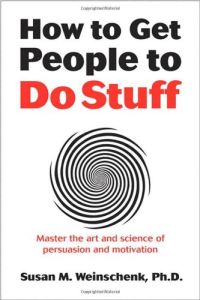
How to Get People to Do Stuff
Book

How to Get People to Do Stuff

Master the Art and Science of Persuasion and Motivation

New Riders, 2013 plus...

Buy the book


Editorial Rating

8

getAbstract Rating

  • Applicable

Recommendation

Behaviorist Susan M. Weinschenk explains how to persuade others to “do stuff” you want done by using the findings of neuroscience and psychology to tap into seven basic human motivational drives: “the need to belong, habits, the power of stories, carrots and sticks, instincts, the desire for mastery,” and “tricks of the mind.” She cites scientific studies that affirm some aspects of the “folk wisdom” of motivation and overturn many others, triggering a revolution in behaviorism. Though Weinschenk skates over issues of potential manipulation, she packs smart insights into her punchy, unflinchingly practical book. getAbstract recommends her guidance to managers, marketers and leaders seeking straightforward, evidence-based strategies for influencing and persuading people.

Summary

Intrinsic Drives and Real Motivations

What drives people to act? What motivates your employees? If you knew, you would get more out of your interactions with them, and so would they, including deeper commitment, clearer communication and greater engagement. You would be able to get them “to do stuff” that you need to get done by working with what they want to achieve. To that end, turn to scientific and psychological studies that reveal useful information about human motivation. Applying psychology to interpersonal relations can make you a better leader and communicator. Start by working with the “seven drives” that motivate people:

1. “The Need to Belong”

Most people yearn to be insiders. Humans evolved to want to interact with each other. Use these strategies to evoke people’s “sense of belonging”:

  • Build social connection – Students worked harder on shared tasks when they thought they shared a birthday with others in the group. People care what others think.
  • Use nouns instead of verbs – The way you phrase a request can strengthen people’s sense of group membership. For example, ask someone to become a donor, rather than asking...

About the Author

Psychologist and behavioral scientist Susan M. Weinschenk, PhD, also wrote 100 Things Every Designer Needs to Know About People and Neuro Web Design: What Makes Them Click?


Comment on this summary

  • Avatar
  • Avatar
    M. M. 7 years ago
    Another great book! It’s incredible that as many other important management tools you have to try to keep things simple, honest and close to the people. Great 7 ways to evolve and be more effective to get things done. #getMotivated #getAbstract <br> <br>Mario
  • Avatar
    A. 7 years ago
    I found this summary a bit hard to follow. There are ideas presented such as anchoring that may need the full text to fully understand and apply.
  • Avatar
    A. A. 7 years ago
    Very helpful. Summarises what to use it in real life and how to get benefit of it. Thanks.

More on this topic

Related Skills

AI Transformation
Développer son intelligence émotionnelle
Construire et entretenir le bien-être
Communiquer efficacement
Convertir les prospects
Développer sa capacité de réflexion
Améliorer l'expérience de ses employés
Direction exécutive
Promouvoir une culture de l'innovation
Foster Team Culture
Ressources Humaines
Innovation
Diriger de façon éthique
S’auto-diriger
Leadership
Leverage AI in Your Daily Tasks
Bien vivre
Manage Learning and Development
Gérer les performances
Management
Marketing
Savoir collaborer
Maîtriser le content marketing
Développement personnel

Promouvoir la diversité, l'équité et l'inclusion

Vente
Compétences relationnelles
Understand Economics
Renforcer la cohésion de l'équipe
Développer ses compétences interpersonnelles
Use AI for Personal Productivity
Utiliser la gamification
S’adapter à la politique de l’entreprise
Pratiquer le Servant Leadership
Exercer une influence
Atténuer les préjugés cognitifs
Renforcer la sécurité psychologique
Comprendre les comportements sociaux
Éviter la procrastination
Économie comportementale
Oser se montrer vulnérable
Comprendre le comportement des consommateurs
Se comprendre soi-même
Comprendre la cognition
Compétences professionnelles
Comprendre les comportements humains
Tisser des liens avec les prospects
Vaincre la solitude
Vivre intentionnellement
Persuader efficacement
Raconter des histoires convaincantes
Gérer son temps
Se motiver
Créer un sentiment d'appartenance
Apprendre par soi-même
Devenir plus productif
Cultiver l'autodiscipline
Comprendre la motivation
Instaurer des habitudes utiles