
Ignorer la navigation
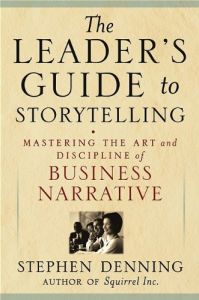
Leader's Guide to Storytelling
Book

Leader's Guide to Storytelling

Mastering the Art and Discipline of Business Narrative

Jossey-Bass, 2005 plus...

Buy the book


Editorial Rating

7

getAbstract Rating

  • Applicable

Recommendation

Stephen Denning has written a carefully reasoned, thought-provoking study of the use of storytelling as a powerful tool for leadership and innovation. He challenges traditional business approaches to management and persuasion, such as relying on analytic thinking, and facts and figures to convince an audience. Instead, Denning says, you can use well-scripted, well-constructed stories to achieve all your leadership goals, both inside and outside of your company. He carefully explains how to tell purposeful stories, and he even provides useful templates at the end of each chapter. The book is much too in-depth to be a handy "how to" manual; in fact, it is more of an enjoyable intellectual exercise because Denning weaves practical instruction within pages of theory. getAbstract recommends this book to leaders who want to extend their persuasive powers by learning to tell purposeful, impassioned stories.

Summary

Why Tell a Story?

Most people believe that businesses operate on a foundation of facts, figures and analysis. Yet, even the simplest narrative can spark the imagination and galvanize people into action better than dry data alone. That makes storytelling a tool leaders can use to transform numbers, research and analysis into compelling, motivating images.

Mastering the Art

Everyone has the capacity to tell a captivating story. You do not have to be a skilled actor to practice the performance art of storytelling. You do, however, need to master the four basic skills of storytelling: "style, truth, preparation and delivery." A simple, direct style is the most suitable approach for a business narrative. Speak as if you are talking to one individual, not a huge audience. Be straightforward, stay focused and do not prevaricate or digress. Most of all, be yourself and tell your story as if you are telling it for the first time.

Today’s audience members are cynical. They are accustomed to hearing spin, half-truths and even outright lies. Tell your story as truthfully and honestly as possible. Proceed on the assumption that what you are communicating is true, ...

About the Author

Stephen Denning also wrote The Springboard: How Storytelling Ignites Action in Knowledge-Era Organizations, and Squirrel Inc.: A Fable of Leadership Through Storytelling. He is a knowledge-management consultant with international clients including major corporations and the U.S. Army.


Comment on this summary

More on this topic

Related Skills

Développer sa créativité
Carrière
Communiquer efficacement
Convertir les prospects
Concevoir des produits innovants
Développer son organisation
Avenir du travail
Création d’entreprise
Direction exécutive
Générer et qualifier des prospects
Ressources Humaines
Diriger stratégiquement
S’auto-diriger
Leadership
Gérer la communication de l'entreprise
Management
Marketing
Maîtriser le content marketing
Maîtriser la stratégie marketing
Développement personnel
Planifier et élaborer des stratégies de vente
Promouvoir la diversité, l'équité et l'inclusion
Vente
Chercher un emploi
Obtenir des financements
Façonner la culture d'entreprise
Compétences relationnelles
Comprendre les organisations
Compétences professionnelles
Défendre les idées nouvelles
Faciliter le brainstorming de groupe
Gérer les limites de l'équipe
Communiquer l'objectif de l'entreprise
Faire preuve d’authenticité
Communiquer sur la stratégie d'entreprise
Créer un sentiment d'appartenance
Manage People and Talent
Structurer l'innovation
Persuader efficacement
Maîtriser le branding
Développer ses compétences interpersonnelles
Gérer les équipes de vente
Promouvoir une culture de l'innovation
Nouvelles approches de leadership
Pitcher son projet d'entreprise
Définir les valeurs fondamentales
Exercer une influence
Collaborer avec créativité
Renforcer la cohésion de l'équipe
Promouvoir la collaboration
Comprendre la dynamique d'équipe
Développer son image de marque
Motiver son équipe
Encourager la collaboration interfonctionnelle
Drive Team Performance
Miser sur l'ambidextrie organisationnelle
Comprendre les approches de leadership
Découvrir des études de cas sur l'innovation
Innover stratégiquement
Comprendre l'innovation
Tisser des liens avec les prospects
Foster Team Culture
Savoir collaborer
Prendre la parole en public
Innovation
Raconter des histoires convaincantes
Strengthen Team Collaboration