

Ignorer la navigation


Editorial Rating

8

getAbstract Rating

  • Applicable
  • Overview
  • Inspiring

Recommendation

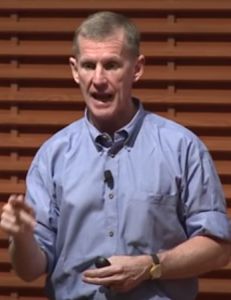
Drawing on his experience as head of the US Joint Special Operations Command, retired four-star general Stanley McChrystal outlines the fundamentals of leadership as it is practiced in a complex, rapidly changing environment. He emphasizes leading by influence and example, building strong and trusting relationships, and creating collaborative, cohesive teams. Personal integrity, discipline, inclusive team-building and high-quality communication are the hallmarks of his approach to being an effective leader. In this Stanford Business School video, McChrystal asserts that worthy leaders know what to do, and have the commitment and discipline to do it.

Summary

Leadership must change when circumstances and challenges change.

Failures in leadership in the United States aren’t due to the country becoming stupid, soft or selfish. The pace of events and communication have increased dramatically, and bureaucratic systems haven’t kept pace. Complexity has increased and the discipline and responsiveness of US leadership systems haven’t grown proportionally.

The United States faced the rise of Al Qaeda – a globally dispersed, culturally unfamiliar, violently aggressive organization with constantly shifting tactics and leadership. A new solution brought together US intelligence agencies, the State Department and the FBI, all partnering and coordinating with allied nations. Creating and leading an effective team across this diverse spectrum of organizations – civilian and military, domestic and international – presented a complex challenge.

Leaders must align their organizations around “shared consciousness and purpose.”

To bring a complex team together, especially one without a unified command structure, you must lead by influence. Even in the military, influence is the primary leadership...

About the Speaker

Stanley McChrystal, a retired four-star general in the United States Army, served as Commander of the Joint Special Operations Command from 2003 to 2008 and was the top US military officer in Afghanistan from 2009 to 2010.


Comment on this summary

More on this topic

Related Skills

Faire progresser sa carrière
Apprendre à s'adapter
Carrière
Communiquer efficacement
Rédiger un business plan
Transformation numérique
Enable Digital Organization
Création d’entreprise
Promouvoir une culture de l'innovation
Ressources Humaines
Innovation
Diriger la planification opérationnelle
Gérer la communication de l'entreprise
Gérer des équipes et des départements
Management
Marketing
Développer ses compétences interpersonnelles
Développement personnel
Planifier et élaborer des stratégies de vente
Planifier stratégiquement
Vente
Comprendre les organisations
Compétences professionnelles
Strengthen Team Collaboration
Navigate Leadership Challenges
Encourager la collaboration interfonctionnelle
Gérer ses relations avec ses supérieurs
Évoluer en tant que femme dirigeante
Manage People and Talent
Oser se montrer vulnérable
Études de cas sur la direction exécutive
Renforcer la sécurité psychologique
Diriger stratégiquement
Diriger en cas de crise
Communiquer sur la stratégie d'entreprise
Diriger de façon éthique
Compétences relationnelles
S’auto-diriger
Faire preuve d'humilité
Comprendre les approches de leadership
Faire preuve d’authenticité
Drive Team Performance
Définir l'objectif, la vision et la mission
Direction exécutive
Gérer le changement
Diriger de façon inclusive
Gérer les équipes de vente
Développer un état d'esprit de croissance
Leadership
Impulser le changement en douceur
Practice Transformational Leadership
Communiquer stratégiquement
Foster Team Culture
Savoir collaborer
Pratiquer le Servant Leadership
Build Digital Culture
Conduire le changement
Transformer la stratégie en action
Gérer l'impact de son leadership
Communiquer l'objectif de l'entreprise
Construire une vision commune
Façonner la culture d'entreprise