
Ignorer la navigation
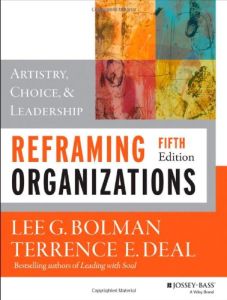
Reframing Organizations
Book

Reframing Organizations

Artistry, Choice, and Leadership

Jossey-Bass, 2013
First Edition: 1984 plus...

Buy the book


Editorial Rating

8

getAbstract Rating

  • Innovative
  • Applicable

Recommendation

Picture yourself in the optician’s chair, looking through the refractor and trying to decipher the test chart on the wall. At first, the chart seems a blur. The optician changes the lens and large letters in the top rows become visible. Lens after lens, your vision improves and you make sense of the chart. Organizational behavior experts Lee G. Bolman and Terrence E. Deal support you in a similar way by offering four “frames” through which to analyze organizations, procedures and dynamics at work. Their 500-page volume – a standard industry textbook in its fifth edition – may not be a “one-minute-manager” breeze, but it’s a rich, readable, applicable reference with cogent examples. getAbstract finds that executives in planning roles as well as business students, entrepreneurs, executives, managers, small-business owners and anyone wanting to understand organizational life will refer to it again and again.

Summary

“Reframing”

As a manager and leader, how do you know if you fully grasp what’s going on around you? “Cluelessness” is widespread in many organizations, and even smart people like Steve Jobs sometimes fail to understand their company and its dynamics. The late Apple CEO didn’t comprehend his corporation’s dynamics, got fired, and came back wiser and stronger.

Being able to think about a given circumstance from multiple perspectives gives you an edge in understanding what’s going on. “Reframing” helps you to come up with alternative judgments of a situation and gives you a set of analytical tools that can lead you to take different actions and use a variety of strategies. Before you reframe, you need new “mental models” – directions, rosters or maps to guide you through your firm’s landscape. Having a mental model or frame helps you scan your environment, look for certain indicators and develop a forward-looking plan.

Highly effective managers have or develop the capacity to use multiple frames. Considering different perspectives helps you challenge your worldview, see organizational life as more than one-dimensional, and use your resourcefulness and bravery to...

About the Authors

Lee G. Bolman works in leadership at the Bloch School of Business and Public Administration at the University of Missouri–Kansas City. Terrence E. Deal co-authored 23 organization and leadership books.


Comment on this summary

More on this topic

Related Skills

Faire progresser sa carrière
Développer sa créativité
Développer son intelligence émotionnelle
Apprendre à s'adapter
Carrière
Développer son organisation
Développer sa capacité de réflexion
Avenir du travail
Drive Team Performance
Foster Team Culture
Ressources Humaines
Innover stratégiquement
Innovation
Diriger la planification opérationnelle
Gérer le changement
Manage Learning and Development
Gérer les performances
Management
Savoir collaborer
Développement personnel
Façonner la culture d'entreprise
Compétences relationnelles
Strengthen Team Collaboration
Comprendre l'innovation
Compétences professionnelles
Diriger de façon éthique
Surmonter les difficultés
Développer un état d'esprit de croissance
S’adapter à la politique de l’entreprise
Gérer l'impact de son leadership
Gérer l'incertitude
Comprendre l'apprentissage organisationnel
Évoluer en tant que femme dirigeante
Practice Transformational Leadership
Comprendre la culture d'entreprise
Miser sur l'ambidextrie organisationnelle
Construire une vision commune
Gérer les relations avec les employés
Diriger stratégiquement
Maîtriser l'approche systémique
Comprendre les organisations
Comprendre les comportements humains
Direction exécutive
Améliorer l'expérience de ses employés
Gérer les limites de l'équipe
Pratiquer le Servant Leadership
Manage People and Talent
Études de cas sur la direction exécutive
Restructurer votre organisation
Nouvelles approches de leadership
Leadership
Se comprendre soi-même
S’auto-diriger
Comprendre les approches de leadership
Prendre conscience de soi
Remettre en question les hypothèses
Conduire le changement
Changer de perspective
Navigate Leadership Challenges