

Ignorer la navigation
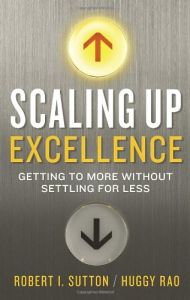
Scaling Up Excellence
Book

Scaling Up Excellence

Getting to More Without Settling for Less

Crown, 2014 plus...

Buy the book


Editorial Rating

9

getAbstract Rating

  • Innovative
  • Applicable

Recommendation

Stanford professors Robert I. Sutton and Huggy Rao team up to address and help solve the difficulties of scaling up. Almost every business has departments or even random pockets of employees who excel. Problems arise when leaders try to spread that excellence to scale throughout a company or in an expansion. Most organizations – regardless of size or specialization – face similar difficulties in spreading best practices or scaling excellence as they grow. The authors use numerous engaging case studies, cite myriad academic papers and offer anecdotal evidence to codify five rules of effective scaling. Surprisingly, given the clean, concise structure of Sutton’s best-selling The No Asshole Rule, here he and Rao don’t always distinguish their revelatory ideas from commonplace notions, and they repeat several points. Even so, this is an accessible, valuable work. getAbstract recommends their perceptive, practical guide to leaders coping with the challenges of scaling.

Summary

“Catholic” or “Buddhist”

Whether your company is a start-up trying to scale or an established firm trying to spread pockets of excellence across your organization, it must strike a balance between duplicating what works – the “Catholic process” – and adapting to new circumstances, the “Buddhist process.”

Scaling excellence is rarely about simple replication. Mimicking a successful process from one unit in your organization in another unit will not change your corporate culture. A clone of a model that works in one culture won’t necessarily work in another. When Home Depot entered China in 2006, it tried to insert its “do it yourself” values into a “hire-someone-to-do-it” culture – and failed completely. By contrast, Yum restaurants succeeded in China by adapting its menus and taking a more flexible, Buddhist-style approach to growth. Few organizations can succeed by turning their backs on what worked in the past. Most success stories feature a balance between adhering to proven processes, standards and ways of doing things, and adapting, where necessary, to new or local conditions as the organization scales.

Balance

To find the right balance, don’t accept...

About the Authors

Professor Robert I. Sutton teaches management science and engineering at Stanford University, where professor Huggy Rao teaches organizational behavior in the Graduate School of Business.


Comment on this summary

More on this topic

Related Skills

AI Transformation
Attirer et recruter des talents
Développer sa créativité
Apprendre à s'adapter
Develop Team Members
Développer son organisation
Transformation numérique
Améliorer l'expérience de ses employés
Execute Digital Operations
Promouvoir une culture de l'innovation
Ressources Humaines
Innover stratégiquement
Innovation
Diriger de façon éthique
S’auto-diriger
Bien vivre
Manage People and Talent
Management
Savoir collaborer
Développer ses compétences interpersonnelles
Développement personnel
Promouvoir la diversité, l'équité et l'inclusion
Compétences relationnelles
Strengthen Team Collaboration
Compétences professionnelles
Direction exécutive
Faciliter le brainstorming de groupe
Élaborer une stratégie d'embauche
Leadership
Rechercher l'excellence
Practice Transformational Leadership
Axer le recrutement sur la diversité
Vivre intentionnellement
Gérer les limites de l'équipe
Mettre en place la méthode agile
Créer sa marque employeur
Encourager la collaboration interfonctionnelle
Développer la tolérance à l'échec
Encourager l'expérimentation
Leverage AI for Management
Déléguer efficacement
Façonner la culture d'entreprise
Soutenir le développement des leaders
Encourager l'amélioration continue
Renforcer la cohésion de l'équipe
Drive Team Performance
Faire preuve d'humilité
Développer un état d'esprit de croissance
Renforcer la sécurité psychologique
Miser sur l'ambidextrie organisationnelle
Pratiquer le Servant Leadership
Foster Team Culture
Récompenser les contributions des employés
Créer un sentiment d'appartenance
Motiver son équipe
