
Ignorer la navigation
The B Corp Handbook, Second Edition
Book

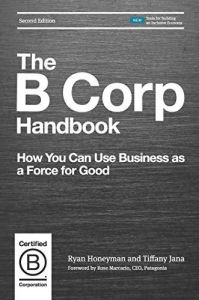
The B Corp Handbook, Second Edition

How You Can Use Business as a Force for Good

Berrett-Koehler, 2019 plus...

Buy the book


Editorial Rating

8

getAbstract Rating

  • Applicable
  • Concrete Examples
  • For Beginners

Recommendation

Ryan Honeyman and Tiffany Jana detail the process of becoming a US Certified B Corp, the benefits and obligations of that status – based on corporate social responsibility – and the values and goals of the B Corp movement. They identify policies and practices in five areas – worker, community, environment, customer impact and company governance – that confer B Corp “certification” points. This handbook provides practical guidance, commentary from B Corp leaders, and specific ideas on how to increase your company’s “diversity, equity and inclusion.”

Summary

Any for-profit US business can achieve B Corp certification, which denotes significant efforts in corporate social responsibility.

Although the “B” in B Corp stands for “benefit,” under US law, B Corps and benefit corporations are not identical. Any for-profit business entity can earn B Corp status, regardless of its legal structure or location. B Corps go through a rigorous process of evaluation to determine whether they are exercising corporate social responsibility and acting as a force for good. Becoming a benefit corporation enables a company to ensure its governance will continue to serve a broader range of stakeholders beyond its shareholders alone.

B Corps must show their dedication to serving humanity by improving the environmental and social well-being of all stakeholders. B Corp businesses can be sole proprietorships, LLCs or partnerships; nonprofits are not eligible. Corporations that want to achieve B Corp certification in jurisdictions that offer benefit corporation status must reincorporate as benefit corporations to retain their B Corp status beyond initial certification. A company legally structured...

About the Authors

Ryan Honeyman is a partner/worker-owner at LIFT Economy. He assists companies in becoming B-Corps and making the most of their certification. Dr. Tiffany Jana is founder and CEO of TMI Portfolio, which advances social responsibility, diversity, inclusion and equity in business.


Comment on this summary

More on this topic

Related Skills

Développer son intelligence émotionnelle
Rédiger un business plan
Secteur public
Avenir du travail
Création d’entreprise
Direction exécutive
Govern Compliance and Risk
S'ouvrir aux autres cultures
Diriger stratégiquement
Leadership
Bien vivre
Gérer la communication de l'entreprise
Gérer les performances
Gérer les opérations de la chaîne logistique
Management
Perspectives de marché par secteur
Marketing
Développement personnel
Planifier stratégiquement
Production et logistique
Promouvoir la diversité, l'équité et l'inclusion
Vente
Compétences relationnelles
Understand Economics
Mener des enquêtes auprès de ses employés
Discover Sustainability Case Studies
Protéger la santé mentale de ses employés
Communiquer sur la stratégie d'entreprise
Promouvoir l'innovation durable
Réglementation du secteur public
Découvrir les changements sociétaux
Définir la gouvernance d'entreprise
Comprendre l'intérêt commercial des critères ESG
Gérer les relations après-vente
Comprendre les comportements humains
Construire une culture inclusive
Manage People and Talent
Définir l'objectif, la vision et la mission
Améliorer l'expérience client
Susciter l'engagement des employés
Promouvoir l'inclusion des personnes handicapées
Comprendre la dégradation environnementale
Ressources Humaines
Mettre en œuvre le reporting et la conformité ESG
Gérer la réclamation client
Promouvoir l'inclusion ethnique
Développer des stratégies d'adaptation au climat
Fidéliser ses employés
Gérer les comptes clients
Proposer des modalités de travail flexibles
Inégalités
Renforcer l'orientation client
Construire et entretenir le bien-être
Comprendre les risques climatiques
Gérer les relations avec les employés
Assurer un service exceptionnel
Comprendre l'économie de l'environnement
Mettre en œuvre des technologies vertes
Mettre en œuvre des stratégies ESG
Comprendre le changement climatique
Garantir le bien-être de ses employés
Communiquer l'objectif de l'entreprise
Promouvoir l'inclusion socio-économique
Améliorer l'expérience de ses employés

Gérer les risques climatiques
Assurer la durabilité de la chaîne logistique
Durabilité
Vivre durablement
Réduire son empreinte carbone