
Ignorer la navigation
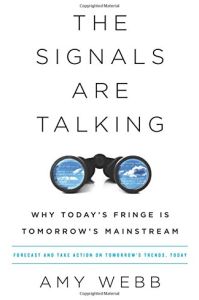
The Signals Are Talking
Book

The Signals Are Talking

Why Today’s Fringe Is Tomorrow’s Mainstream

Public Affairs, 2016 plus...

Buy the book


Editorial Rating

8

getAbstract Rating

  • Analytical
  • Innovative
  • Concrete Examples

Recommendation

In this witty, mostly nontechnical primer, futurist Amy Webb outlines the steps that futurists use to predict coming trends. She even answers the age-old question: Why don’t we have flying cars yet? Webb, the founder of the Future Today Institute, says trends begin as experiments on the fringes of science and society. She explains how to discern “signals” and patterns among seemingly unconnected experiments, how to extrapolate possible future scenarios from them and how to devise appropriate strategies for each scenario. She also shows how to distinguish real trends from merely trendy ideas. Her enjoyable read has a few patches that aren’t as easy to understand as the rest of the book, spots where Webb buries her points under technical details or arcane examples. And, just to post a warning, the report on one case history about a chatbot that went rogue cites ethnic slurs and biased ideations. Despite these difficulties, getAbstract believes the principles in Webb’s mind-bending book will aid business and marketing strategists, planners and venture capitalists.

Summary

Things to Come

Spotting trends before they fully emerge in the mainstream is an essential skill for leaders in business or government. But too many planners focus myopically on current issues and ignore the “signals” that change is underway in the technological, scientific or cultural environment. Unless you specifically look for these signals, they can be difficult to notice. They generally originate on the fringes of scientific or cultural thought and often appear to be nothing more than random, unconnected outliers.

However, if you apply some techniques developed by professional futurists, you can determine if seemingly random developments follow a pattern. If you detect patterns and then can connect one fringe idea to others or to events already in the mainstream, you might spot the first stirrings of a new trend that will eventually emerge in the mainstream.

Why Leaders Miss Trends

If you’re an expert in your field, you can easily persuade yourself that a particular idea from the fringe is probably impractical. But you might be reaching that judgment without correcting for a bias called the “paradox of the present...

About the Author

Amy Webb is a quantitative futurist and founded the Future Today Institute. She is a professor of strategic foresight at New York University’s Stern School of Business. 


Comment on this summary

  • Avatar
  • Avatar
    A. R. 5 years ago
    Interesting topic, however as English is not my mother tongue, can someone explain if the term "fringe" is intended to mean "at the edge of something" or is meant to be something atypical? That clarification would help my understanding of the author's ideas

More on this topic

Related Skills

Faire progresser sa carrière
Développer sa créativité
Carrière
Develop Financial Literacy
Secteur agricole
Secteur automobile
Secteur de la construction
Secteur du conseil
Discover Economy
Secteur de l'énergie
Secteur financier
Secteur de l'assurance
Secteur industriel
Industrie pharmaceutique
Secteur public
Industrie du sport
Secteur technologique
Secteur des télécommunications
Secteur du tourisme
Secteur du transport et de la logistique
Création d’entreprise
Direction exécutive
Ressources Humaines
S'ouvrir aux autres cultures
Innovation
Gérer l'innovation produit
Gérer les risques
Management
Perspectives de marché par secteur
Marketing
Développement personnel
Compétences relationnelles
Understand Economics
Compétences professionnelles
Avenir du secteur automobile
Créer une adéquation produit-marché
Avenir du secteur agricole
Avenir de l'industrie pharmaceutique
Comprendre l'innovation
Utiliser la planification de scénarios
Générer des idées
Avenir du secteur des télécoms
Avenir du secteur transport et logistique
Indicateurs économiques
Avenir du secteur touristique
Avenir du secteur de l'assurance
Nouveaux modèles de travail
Concevoir des produits innovants
Avenir du secteur du conseil
Avenir du secteur industriel
Planifier stratégiquement
Avenir du secteur de l'énergie
Suivi de tendance
Avenir du secteur de la construction
Compétences futures
Avenir du secteur public
Avenir de l'industrie du sport
Remettre en question les hypothèses
Avenir du secteur technologique
Avenir du travail
Découvrir les tendances marketing
Découvrir les changements sociétaux
Tendances des marchés émergents
Avenir du secteur financier
Découvrir les tendances culturelles